TL;DR | Networking Trips vs Traditional Business Trips in China
In China, the outcome of a business visit is driven less by travel logistics and more by access, introductions, and context. Executives typically choose between a traditional, self directed business trip, which offers high control and works best for progressing specific deals or due diligence, and a structured group format such as a business expedition or delegation, which is designed for curated access, facilitated networking, and faster market learning.
Traditional trips work well when you already have senior meetings confirmed and strong local support. They can fall short when access stays at an intermediary level, leading to a busy schedule with limited decision grade insight. Structured formats can reduce single source bias, increase the number of high value conversations in a short timeframe, and improve time to clarity when you are exploring new sectors, partners, or cities.
The right choice depends on your stage. Execution, negotiation, and targeted due diligence usually favour a traditional trip. Early stage exploration, comparison, and ecosystem understanding often benefit from a more structured approach.

Entering China for the first time (or returning after a long gap) can feel deceptively straightforward: book flights, schedule meetings, visit partners, and “see the market.” In practice, the outcomes of a China business trip often depend less on travel logistics and more on whether you can secure the right introductions, interpret signals correctly, and build trust in a compressed timeframe.
Many executives return from China saying the same thing: “We did a lot, but we’re not sure what we learned.” That usually isn’t a capability issue. It’s a format issue. In China, access, introductions, and context often determine how much signal you can extract in a short visit, and whether conversations move beyond surface level.
Executives typically take one of two approaches. The first is a conventional, self directed trip planned around specific meetings and site visits. The second is a structured group format, sometimes called a China business expedition, designed to create deeper access and reduce uncertainty through facilitated introductions and a curated agenda. This guide compares traditional business trips with structured group visits, with a focus on networking depth, stakeholder access, risk, and decision quality outcomes.
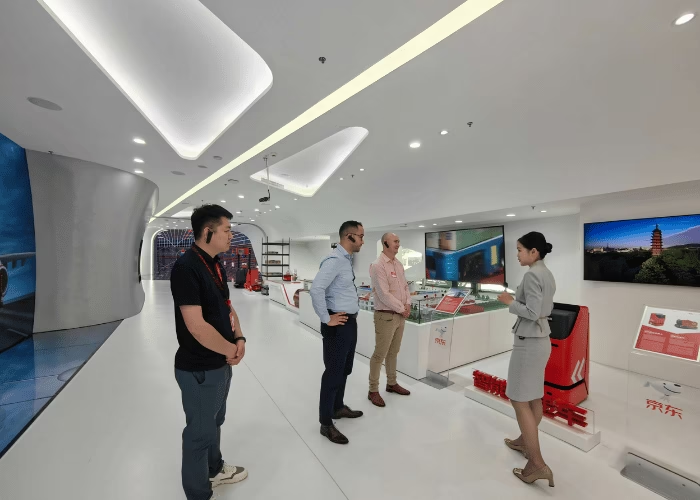
In China, the quality of access shapes the quality of insight. A packed calendar means little if you can’t reach the right decision-makers.
What a Traditional China Business Trip Looks Like
A traditional China business trip is usually an individual company-led visit where you define your objectives, choose cities, and schedule meetings directly. The intent is often clear and tactical:
- Validate demand, pricing, or channels
- Meet distributors, suppliers, or prospective partners
- Visit factories or offices for due diligence
- Attend a trade show or industry event
- Progress an existing negotiation
This format works well when you already have established relationships in-country, strong local support, or a clear pipeline of meetings with decision-makers. It also offers control: you set the agenda, choose who to meet, and move at your own pace.
The challenge is that China is an “access-sensitive” market. If your meetings are limited to people already within your network, you can leave with a lot of activity—yet limited new intelligence. Many first-time visitors also underestimate the time required to confirm attendees, align expectations, and avoid last-minute changes, especially when multiple stakeholders are involved.
What Defines a Business Delegation or Business Expedition
A business delegation is a structured group visit designed around curated access, facilitated networking, and a coherent agenda. Some organisations describe this as a China business expedition to emphasise market immersion rather than a single purpose trip.
While formats vary, a delegation typically includes:
- A curated itinerary focused on specific sectors or themes
- Pre-arranged briefings, visits, and moderated sessions
- Facilitated introductions that would be difficult to secure alone
- A peer group of participants, often with aligned seniority
- On-the-ground coordination (interpretation, logistics, local context)
The point is not “touring.” The point is compressing the discovery and relationship-building process into a tight window, with fewer dead ends. For executives exploring a new market, this structure can make the difference between leaving with general impressions versus leaving with actionable insights and credible next steps.
Quick Comparison: Traditional Trip vs Delegation Format
Dimension | Traditional China business trip | Delegation / business expedition format |
Primary purpose | Execute specific meetings, negotiations, or due diligence | Accelerate learning + access through a structured agenda |
Agenda control | Full control (you design and adjust) | Shared structure (curated schedule + facilitated sessions) |
Access quality | Strong if you already have senior introductions | Often broader access across multiple stakeholders |
Networking style | One-to-one, relationship depth depends on your network | Facilitated networking + peer context from group format |
Information breadth | Can be narrow if meetings rely on one source | Often wider perspectives in a short timeframe |
Planning effort | High (scheduling, routing, interpretation, coordination) | Typically lower (more pre-arranged and coordinated) |
Common risk | Busy schedule with limited strategic insight | Less flexibility; value depends on agenda relevance |
Best fit | Later-stage execution, specific deals, repeat visits | Early-stage exploration, comparison, rapid market calibration |
Business Networking in China: Individual Meetings vs Group Access
Business networking in China tends to be relationship-led and context-heavy. Introductions matter, and credibility often transfers through trusted intermediaries. That does not mean deals are closed over dinner, but it does mean that trust and social proof can affect whether you get access to senior people, candid answers, or follow-up momentum.
On an individual trip, your networking depth depends on:
- Existing connections (or how quickly you can build them)
- The perceived seniority and intent of your visit
- The quality of interpretation and local guidance
- Your ability to follow local norms without overcorrecting
You can build meaningful relationships this way, but it often takes repeated visits and local presence. If you are early in the process, many meetings remain exploratory and can be overly polite, with limited “signal” beyond what you already knew.
In a delegation setting, networking tends to be:
- More facilitated (introductions happen with context)
- More time-efficient (multiple touchpoints in a short span)
- More candid (people often speak more openly in moderated formats)
- More diversified (you can compare perspectives across stakeholders)
A group format can also reduce the “single-thread risk,” where your market view is shaped by one partner, one distributor, or one adviser. You are exposed to multiple angles quickly, which is valuable when you are still calibrating what is real versus what is said.

Access to Companies and Institutions: Why It Changes the Trip Outcome
A common reason executives feel underwhelmed after a first China business trip is not a lack of effort—it is a lack of access to the right layer of the ecosystem. If your agenda is limited to sales representatives, junior staff, or intermediaries, you may not get the strategic insight needed for a go/no-go decision.
Traditional trips can secure strong access when you already have:
- Existing partners willing to “open doors”
- Clear commercial intent that justifies senior time
- A local team that can navigate scheduling and etiquette
- A targeted list of stakeholders with defined asks
However, if you are entering a new space (new city, new sector, new channel), it can be difficult to reach decision-makers quickly—especially in large organisations or regulated areas.
Structured formats often aim to broaden access across:
- Corporate ecosystems (platforms, operators, service layers)
- Institutions (associations, policy or investment briefings)
- Operators (brands, marketplaces, supply chain actors)
- Category experts (who can explain how decisions are made)
The advantage is not “prestige visits.” The advantage is context: understanding how relationships, incentives, and constraints shape what is feasible in the market.
A China visit fails most often at the access layer: if you only meet intermediaries, you leave with activity—not decision-grade insight.
Cost, Time, and Risk: The Real Comparison Executives Should Make
Executives often compare formats using visible costs—flights, hotels, and event fees. A better comparison includes hidden costs and opportunity costs.
Time to Value
- Traditional trip: More time spent planning, confirming meetings, and troubleshooting gaps. Returns are strong if meetings are high-quality; weak if agendas drift or contacts stall.
- Delegation/expedition: More time is “pre-structured,” which can increase the ratio of useful hours on the ground—especially for first-time exploration.
Information risk
- Traditional trip: Higher risk of receiving curated narratives from a small number of stakeholders.
- Delegation/expedition: Lower risk of single-source bias if the agenda exposes you to multiple perspectives.
Execution risk
- Traditional trip: You carry coordination risk (interpretation, transport, meeting etiquette, location sequencing, local troubleshooting).
- Delegation/expedition: Coordination is often centralised, reducing friction and allowing executives to focus on decision-quality conversations.
Relationship risk
- Traditional trip: Strong if you can sustain ongoing engagement; fragile if follow-up relies on one champion.
- Delegation/expedition: Can create multiple relationship threads quickly, but still requires disciplined follow-up once home.
The bottom line: a “cheaper” trip can be more expensive if it produces unclear outcomes, misreads the market, or delays decisions by months.
Why Some Executives Choose a China Business Delegation Format
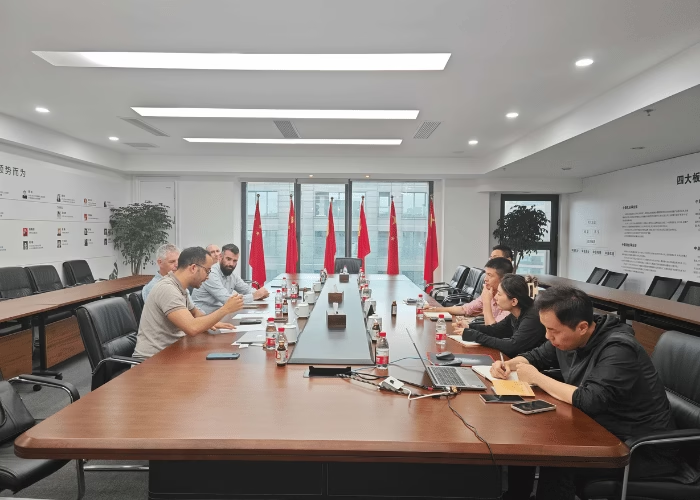
In practice, some executives choose a delegation model when they need to accelerate learning and reduce uncertainty—particularly when they lack deep local networks or are exploring multiple options at once.
This format can help by:
- Curating access: Creating introductions to relevant stakeholders beyond existing contacts
- Structuring the agenda: Sequencing briefings and meetings so insights build logically
- Facilitating networking: Providing context and credibility that improves the quality of conversations
- Reducing time waste: Minimising “empty” days caused by cancellations, misalignment, or poor scoping
- Improving decision quality: Exposing leaders to multiple perspectives in a short window
For executives seeking structured access, a curated China business delegation may be more effective.
Importantly, this is not a replacement for long-term market presence. It is a way to make early-stage exploration more decisive—so you can determine whether you need a local hire, a partner strategy, a deeper due diligence cycle, or a revised market entry thesis.
When Each Option Makes Sense
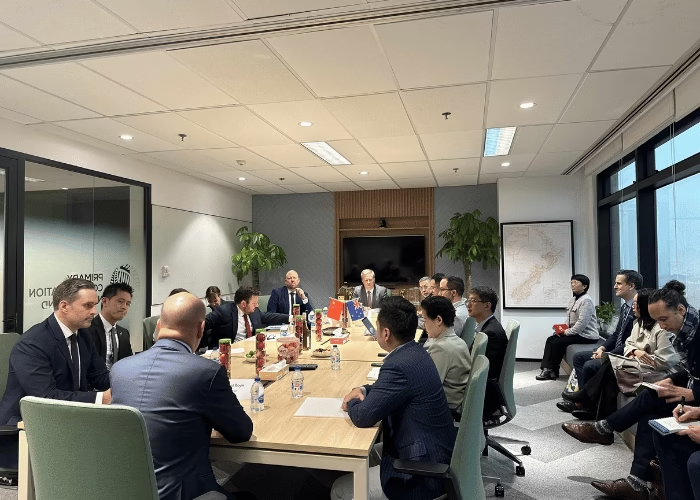
Different strategic contexts call for different formats. The decision becomes clearer when you map the trip format to the stage of your China work.
A traditional China business trip tends to make sense when:
- You have warm introductions and confirmed senior meetings
- You are progressing a specific deal with clear next steps
- You need targeted due diligence (site visit, audit, contract discussions)
- You have a local team or partner who can coordinate effectively
- You are returning to deepen an existing relationship
A China business expedition or delegation format tends to make sense when:
- You are in exploration mode and need broad, credible market insight
- You want to compare options (partners, cities, models) quickly
- Your network is limited and you need facilitated introductions
- You want to understand how business networking in China actually functions in your sector
- You have limited time and need a high signal-to-noise itinerary
Choose the trip format that matches your stage: execution needs control; exploration needs structure, context, and diversified perspectives.
Practical Takeaways
If you remember only a few things, keep these in mind:
- The success of a China visit is often determined by access and context, not travel comfort or the number of meetings.
- A traditional trip is powerful when you have clear objectives and strong local coordination; otherwise it can become a series of polite conversations with limited insight.
- A delegation-style approach is most valuable when you need to accelerate learning, diversify your perspectives, and reduce “single-source” market bias.
- Evaluate cost based on decision impact (clarity, next steps, risk reduction), not just line-item expenses.
- Whatever format you choose, plan follow-up before you travel: relationships in China strengthen through continuity, not a single visit.
Conclusion
Both formats—traditional business trips and structured group visits—can be effective in China, but they serve different executive needs. A self-directed trip offers control and depth when you already have the right access. A structured delegation or China business expedition can deliver broader context and facilitated networking when you are still forming your market view and need to move faster with less risk.
For decision-makers, the key is choosing the format that matches your current stage: negotiation and execution versus exploration and calibration. When aligned, your time on the ground stops being “a trip” and becomes a practical step in building durable relationships and informed market strategy.
FAQ on Key Differences Delegations vs Traditional Business Trips in China
What is a China business delegation?
A China business delegation is a structured, group based visit built around a curated agenda and facilitated introductions. It typically focuses on access, context, and high value meetings rather than ad hoc scheduling.
What is the difference between a China business delegation and a China business trip?
A China business trip is usually self directed and meeting led, with full control over your schedule. A delegation format is more structured, with coordinated briefings, introductions, and an itinerary designed to reduce time waste and improve decision quality.
Is a China business expedition the same thing as a business delegation?
Often, yes. “China business expedition” is commonly used to describe a more immersive, structured format that combines market learning with curated access. The label varies by organiser, but the core idea is a guided, agenda driven approach.
How does business networking in China typically work for foreign executives?
Networking is relationship led and context heavy. Introductions matter, and credibility can transfer through intermediaries. Trust usually builds through continuity, clear positioning, and well prepared follow up, not just one meeting.
Which format is better for first time market exploration in China?
If you are early stage and still forming your market view, a structured format can help you compare perspectives quickly and reduce single source bias. If you already have senior meetings confirmed, a self directed trip can work well.
Which format is better for due diligence and negotiations?
Traditional business trips often suit due diligence, audits, contract work, and negotiations because you control timing, participants, and technical depth. Structured formats can still support this, but they are usually better for discovery and context building.
What are common mistakes executives make on a China business trip?
Relying on too few sources for market insight, meeting only intermediaries, underestimating scheduling complexity, and treating meetings as one off events rather than relationship building steps with planned follow up.
How can executives judge whether they are getting “real signal” in meetings?
Look for specificity, consistency across multiple stakeholders, clear next steps, and willingness to discuss constraints. If conversations stay polite and general, it may be an access or positioning issue.
How many days do you need for a productive China business trip?
It depends on the number of cities and meeting density, but executives often underestimate travel friction and rescheduling. A shorter trip can work if access is strong and the agenda is tight, otherwise more days do not automatically create more insight.
What should you prepare before any China business visit (trip or delegation)?
A clear objective, a short list of decision questions, stakeholder mapping, meeting briefs, and a follow up plan. Preparation should also include how you will validate what you hear through multiple viewpoints.