
China Tech Tour 2026: AI, Robotics & EV Ecosystems for Investors
A China tech tour is a structured business immersion program that brings foreign investors, executives, and innovation leaders directly into China’s leading technology ecosystems — including AI labs, humanoid robotics factories, and EV manufacturing facilities — to gather first-hand market intelligence that desk research cannot provide. InfluChina’s 2026 China tech tour programs cover Shanghai, Shenzhen, and Hangzhou, targeting three high-growth sectors: generative AI, humanoid robotics, and electric vehicles. With 6+ years of China market experience and 400+ campaigns launched, InfluChina adds a unique consumer intelligence layer — explaining how these technologies reach Chinese consumers via Douyin, Xiaohongshu, and WeChat — that no pure tour operator can replicate. 2026 is the critical window: AI models are converging, humanoid robots are hitting production floors, and China’s EV price war is reshaping global supply chains in real time.
Table of Contents
1. Why Is 2026 the Critical Year to Tour China’s Tech Ecosystem?
2026 represents a convergence point across three of China’s most strategically important technology sectors simultaneously — a window that investors and executives who rely on desk research are already missing. Understanding Chinese consumer behavior and demographics and how they are adopting these technologies is equally essential to any investment thesis.
China’s AI Models Are Closing the Gap — Faster Than Reports Suggest
Generative AI in China — led by DeepSeek, Kimi (Moonshot AI), and Doubao (ByteDance) — has closed the capability gap with Western large language models faster than most Western analyst reports reflect. DeepSeek’s January 2024 release triggered a global reassessment of China’s AI competitiveness, yet Western media coverage consistently lags the on-the-ground reality by 12–18 months.
What a China AI tour reveals that reports cannot:
- Deployment velocity: Chinese AI companies are moving from lab benchmarks to real-world applications in autonomous vehicles, industrial robotics, and retail recommendation systems at a pace that only becomes visible when you are inside the ecosystem.
- Developer community density: The scale of AI adoption across Chinese enterprise software, consumer apps, and government procurement is a structural advantage not reflected in model benchmarks alone.
- Regulatory positioning: China’s AI governance framework — including algorithm transparency requirements — is shaping competitive moat in ways that only emerge through direct conversations with founders and engineers.
Entities worth understanding in person include Baidu’s Ernie Bot, SenseTime’s enterprise AI platform, and the Zhipu AI research cluster. Understanding how Gen Z in China and technology adoption intersects with these platforms adds a consumer lens that pure technical analysis misses.
The Humanoid Robot Race Has Left the Lab
China’s Ministry of Industry and Information Technology (MIIT) issued a national humanoid robot action plan in 2023, targeting mass commercialization by 2025 and global leadership by 2027 — a timeline that is only credible when you see production floors at companies like UBTECH, Unitree, and Fourier Intelligence in person. This is not a future-gazing exercise: these companies are shipping production units today.
What makes China’s humanoid robotics cluster structurally different from global peers:
- Supply chain proximity: Shenzhen’s electronics manufacturing ecosystem means robotics companies can iterate hardware in weeks, not quarters.
- Government procurement pipeline: MIIT’s directive is creating a policy-backed early-adopter market — factory deployments, logistics operations, and public service pilots — that Western robotics companies do not have.
- Manufacturing cost base: On-site visits reveal unit economics that no secondary research source accurately models.
EV Economics Only Make Sense When You See the Factory Floor
China accounted for approximately 60% of global EV sales in 2023, according to the International Energy Agency (IEA) — a market dominance underpinned by a vertically integrated supply chain from CATL’s battery cells through BYD’s in-house manufacturing that investors can only truly assess on-site.
The EV price war that played out between 2023 and 2025 was not simply a race to the bottom. It was the visible output of extraordinary vertical integration — and it only makes analytical sense when you stand inside a BYD facility and trace the supply chain from raw material to finished vehicle. Three dynamics are invisible from a desk:
- Battery economics: CATL’s cell-to-pack manufacturing cost curves are reshaping what is possible at a given price point.
- Software margin recovery: EV manufacturers are recovering margin through over-the-air software subscriptions and data monetization — a model visible in how BYD sells via Douyin (the Chinese version of TikTok) live-stream commerce.
- Supply chain speed: China’s EV companies iterate vehicle models faster than many Western competitors, a reality that only registers when you see production scheduling in person.
Enquire About the 2026 China Tech Tour
2. What Will You See? A Sector-by-Sector Tour Intelligence Brief
A China AI robotics EV tour is not a single itinerary — it is three parallel investment intelligence tracks that intersect at the supply chain and consumer adoption layers. Each sector requires a distinct analytical lens, and each reveals competitive intelligence that a China market entry strategy built on desk research will systematically miss.
AI — From Large Language Models to Real-World Deployment
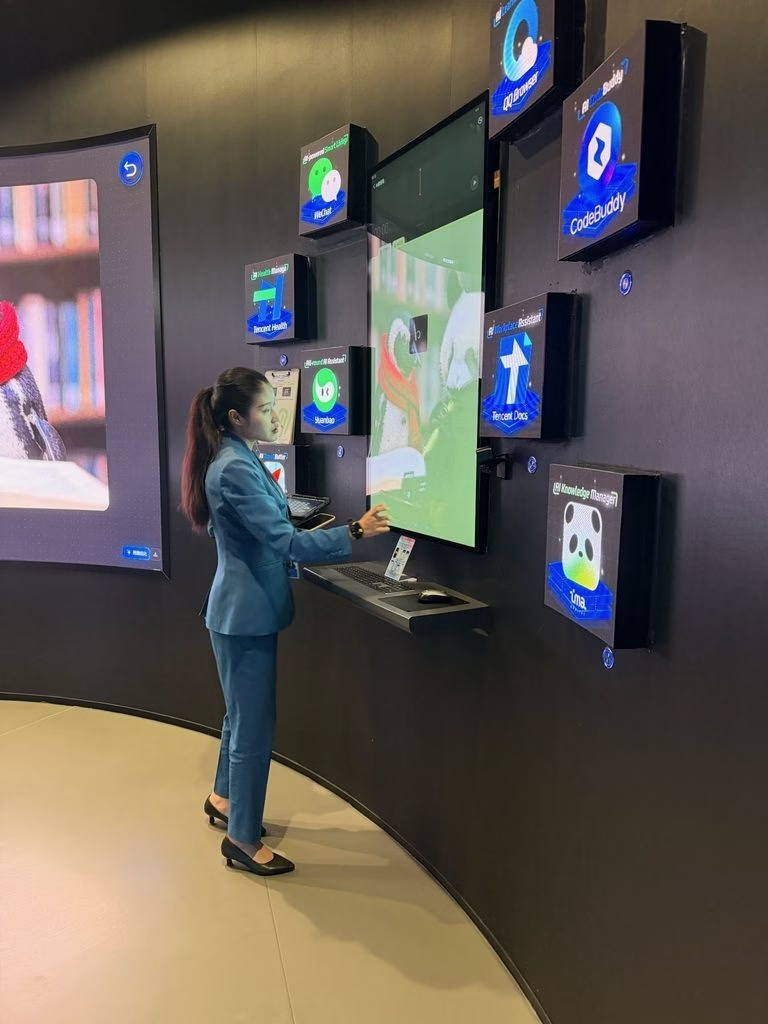
On an AI-focused China tech tour, investors assess not just model capabilities but deployment velocity — how quickly Chinese AI companies are moving from lab benchmarks to real-world applications in autonomous vehicles, industrial robotics, and retail recommendation systems.
Key assessment dimensions on an AI visit:
- Competitive moat: Is the advantage in the model itself, in proprietary training data, or in the distribution channel (e.g., Baidu Apollo’s integration with autonomous vehicle fleets)?
- Data advantage: China’s scale of consumer and industrial data — processed through platforms like Douyin and WeChat — creates training datasets that Western companies cannot legally replicate.
- Regulatory positioning: SenseTime, Zhipu AI, and Moonshot AI (Kimi) each have distinct regulatory relationships that affect their ability to scale in government and enterprise markets.
- Application deployment: From retail recommendation engines to autonomous driving inference chips, seeing AI applied at scale rewrites the valuation framework.
Humanoid Robotics — Factories, Companies, and Commercialization Timelines
China’s humanoid robotics cluster — centered in Shenzhen, Shanghai, and Beijing — is commercializing at a pace that outstrips most Western analyst timelines, driven by MIIT government mandates, deep hardware supply chains, and companies like UBTECH, Unitree, and Fourier Intelligence shipping production units.
What investors assess on a robotics facility visit:
- Hardware iteration speed: UBTECH’s Walker series and Unitree’s H1 platform represent different architectural bets — visible only through direct comparison of production configurations.
- Government procurement depth: Factory deployment contracts and public-sector pilot programs reveal the near-term revenue runway that no prospectus accurately captures.
- Bill of materials: China’s electronics supply chain means a humanoid robot unit cost is declining rapidly — a dynamic that reshapes competitive moat analysis for global peers.
Electric Vehicles and Battery Technology — Beyond BYD
China’s EV ecosystem extends far beyond BYD — encompassing CATL’s battery gigafactories, NIO’s battery-swap infrastructure, Li Auto’s range-extended EV architecture, and the autonomous driving software layer led by Pony.ai and WeRide — each representing a distinct investment thesis.
The five EV sub-sectors worth assessing on tour:
- Vehicle OEMs: BYD (Shenzhen HQ), NIO, and Li Auto each have fundamentally different margin and technology architectures.
- Battery manufacturing: CATL’s cell-to-pack innovation at its Ningde facilities is the single most important supply chain intelligence visit in China’s EV ecosystem.
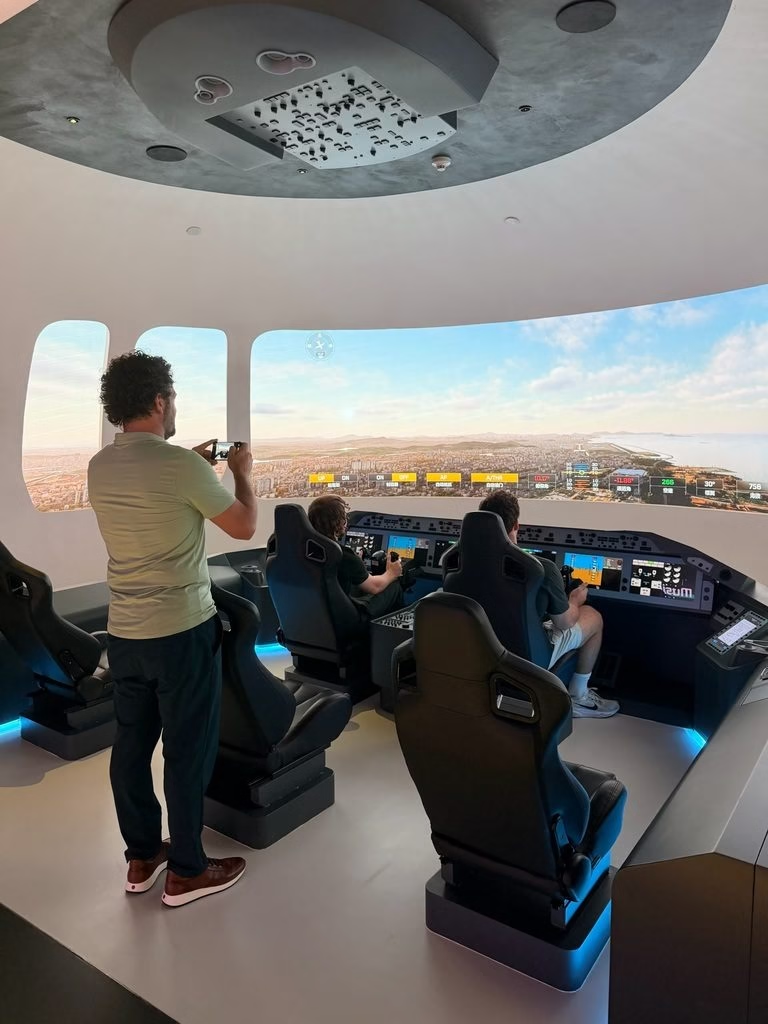
- Autonomous driving software: Pony.ai robotaxi operations and WeRide’s commercial fleet deployments are testable in person — not just in slide decks.
- Digital retail infrastructure: How EVs are sold via Douyin live-stream commerce and Xiaohongshu (also known as Rednote or Little Red Book) reviews is a structural market adoption signal.
- Battery swap networks: NIO’s battery-as-a-service model is a consumer experience and business model innovation visible only through direct use.
China Tech Sector Snapshot 2026
| Sector | Key Players (Examples) | What Investors Assess On-Tour | Why You Can’t Evaluate From a Desk |
|---|---|---|---|
| AI / LLMs | DeepSeek, Moonshot AI (Kimi), Baidu Ernie, SenseTime, Zhipu AI | Deployment velocity, data moat, regulatory positioning, enterprise adoption rate | Model benchmarks don’t capture deployment scale or government contract pipeline |
| Humanoid Robotics | UBTECH (Walker), Unitree (H1), Fourier Intelligence | Hardware iteration speed, unit economics, government procurement pipeline | Production floor visits reveal BOM cost curves and shipping velocity invisible in filings |
| Electric Vehicles | BYD, NIO, Li Auto, Xiaomi EV | Vertical integration depth, software margin recovery, supply chain speed | Price war economics only make sense when you see factory scheduling in person |
| Autonomous Driving | Pony.ai, WeRide, Baidu Apollo | Robotaxi deployment scale, regulatory clearances, software stack architecture | Commercial deployments are testable on-site; analyst reports lag by 12–18 months |
| Battery Technology | CATL (Ningde), BYD Battery, CALB | Cell-to-pack innovation, cost curve trajectory, customer concentration risk | Manufacturing economics and capacity ramp rates require on-site verification |
Source: Company examples are illustrative; confirmed access arranged per cohort. Market data: IEA, MIIT, 2024–2025.
3. Your China Tech Tour Itinerary: City-by-City
The optimal China innovation tour routing is determined by your sector focus — not by geography alone. Shanghai, Shenzhen, and Hangzhou form the core three-city circuit for most investor programs, with Chengdu available as an optional extension for semiconductor and gaming mandates. The table below maps each city to its primary technology sector and the investor profile it serves best.
China Tech Tour City × Sector Guide
| City | Primary Tech Sector | Key Facilities / Company Types | Recommended For |
|---|---|---|---|
| Shanghai | AI Governance, Smart Mobility, Robotics | Shanghai AI Lab, Tesla Gigafactory 3, Lingang robotics cluster, autonomous vehicle testing zones | AI investors, smart mobility funds, regulatory intelligence |
| Shenzhen | EV, Hardware Ecosystem, Supply Chain | BYD global HQ, DJI drone operations, Huaqiangbei electronics market, Foxconn facilities | EV investors, supply chain executives, hardware sourcing |
| Hangzhou | AI Commerce, Fintech, Digital Infrastructure | Alibaba campus, Ant Group fintech HQ, Taobao / Tmall operational hub, Alipay infrastructure | Commerce tech investors, fintech funds, digital payments mandates |
| Chengdu | Semiconductors, Gaming, Emerging AI | Semiconductor design clusters, gaming studio campuses, lower-cost R&D facilities | Semiconductor investors, gaming sector mandates (optional extension) |
| Beijing | AI Research, Policy, ByteDance / Baidu HQ | Baidu campus, ByteDance HQ, AI research institutes, policy and regulatory briefings | AI research investors, policy-focused delegations (reference city) |
Source: Based on InfluChina field research and publicly available ecosystem data, 2025.
Shanghai — AI Governance Hub and Smart Mobility Capital
Shanghai AI serves as China’s AI governance and smart mobility capital — home to the Shanghai AI Lab, Tesla’s Gigafactory 3, the Lingang robotics manufacturing cluster, and the most developed autonomous vehicle testing infrastructure in the country. For investors, Shanghai is the essential first stop because it provides the international business interface and regulatory intelligence layer that frames everything seen in Shenzhen and Hangzhou.
What to assess in Shanghai:
- Shanghai AI Lab: China’s leading open-source AI research institution, benchmarking directly against Western frontier labs.
- Lingang Special Economic Zone: The robotics and EV manufacturing cluster where Tesla, NIO, and domestic robotics companies operate in proximity.
- Autonomous vehicle testing zones: Shanghai has more commercially deployed robotaxi routes than any other Chinese city — testable in person.
Shenzhen — EV Capital, Hardware Ecosystem, and Supply Chain Intelligence
Shenzhen is China’s EV and hardware capital — home to BYD’s global headquarters, DJI’s drone operations, and the world’s most concentrated electronics manufacturing ecosystem, making it the essential destination for any investor assessing China’s technology supply chain.
The Shenzhen visit delivers three distinct intelligence layers:
- BYD vertical integration: Seeing BYD’s in-house battery, semiconductor, and assembly operations in a single visit rewrites the unit economics model for Western EV competitors.
- Huaqiangbei electronics market: The world’s largest electronics component marketplace — a real-time indicator of hardware supply chain pricing and availability.
- DJI and drone ecosystem: DJI’s dominance in commercial drones is a case study in how Chinese hardware companies build global market share from a Shenzhen manufacturing base.
Consider pairing a Shenzhen visit with InfluChina’s China sourcing trips and factory visits for supply chain executives who need manufacturing intelligence alongside investment context.
Hangzhou — Alibaba Ecosystem and Digital Commerce Infrastructure
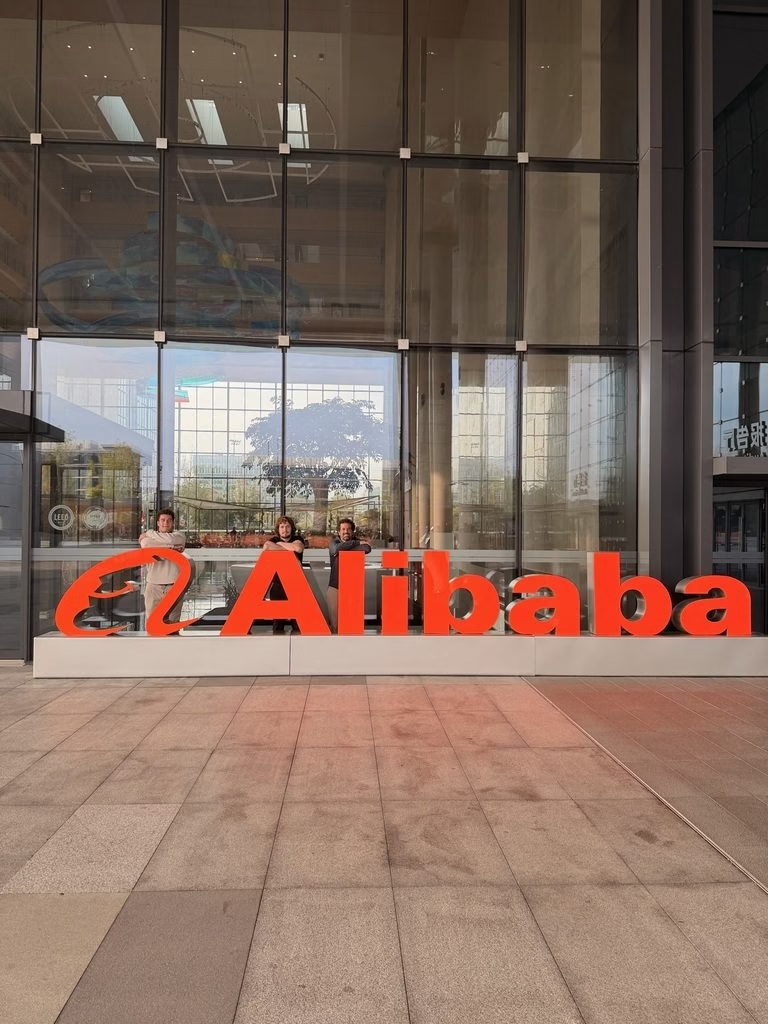
Hangzhou houses Alibaba’s global headquarters and Ant Group’s fintech infrastructure — making it the essential destination for investors assessing how China’s AI, e-commerce, and payments ecosystems converge into a single consumer intelligence layer.
The Alibaba ecosystem visit reveals:
- AI-commerce integration: How Alibaba’s large language model (Tongyi Qianwen) is deployed across Taobao, Tmall, and Alipay creates a unified AI-commerce stack with no Western equivalent.
- Fintech infrastructure: Ant Group’s digital payments infrastructure processes transaction volumes that reframe what "financial infrastructure" means at China’s scale.
- Digital retail data: How Xiaohongshu (Rednote) reviews and Douyin live-stream commerce feed back into Alibaba’s recommendation engine is visible through ecosystem briefings unavailable in any report.
Chengdu — Western China’s Emerging Tech Hub (Optional Extension)
For investors with a semiconductor or gaming mandate, Chengdu offers access to Western China’s emerging technology cluster — a lower-cost R&D environment with a growing semiconductor design community and one of China’s most active gaming studio ecosystems. Flag as an optional 2–3 day extension to a core Shanghai-Shenzhen-Hangzhou circuit.
4. Who Should Join a China Tech Tour?
A China investor tech tour is purpose-built for professionals who need first-hand market intelligence to make capital allocation decisions — not for general business travelers curious about China’s economy. The four audience types below each receive a distinct value proposition from the program.
Venture Capital and Private Equity Investors
Venture capital and private equity investors join China tech tours to validate or challenge investment theses — assessing whether Chinese AI, robotics, or EV companies have the supply chain depth, regulatory tailwinds, and market adoption velocity to justify cross-border exposure.
Specific outcomes for VC/PE participants:
- Deal flow sourcing: Direct introductions to founders and engineers that relationship networks alone cannot access remotely.
- Thesis validation: Stress-testing a China EV or robotics thesis against on-the-ground production realities.
- Competitive moat assessment: Understanding whether a Chinese company’s advantage is replicable by Western peers — or structurally protected by supply chain and regulatory factors.
Corporate Innovation and Strategy Executives
Corporate innovation leaders join to assess whether Chinese tech companies represent a competitive threat, a partnership opportunity, or a supply chain dependency — intelligence that only emerges from direct facility visits and founder conversations.
For corporate executives, the primary question is binary: is this company something to partner with, acquire from, or compete against? A Corporate Delegation to China structured around a specific sector mandate delivers that answer far more efficiently than secondary research.
Fund Managers Building China Exposure
Fund managers building or stress-testing China exposure use tech tours to assess macro sector dynamics — understanding which of China’s three high-growth tech sectors (AI, robotics, EV) has the most durable regulatory tailwinds and consumer adoption velocity before allocating to China-focused funds or ETFs.
Key assessment dimensions for fund managers:
- Regulatory durability: Which sectors have the deepest government support under Made in China 2025 and successor policy frameworks?
- Consumer adoption velocity: Which technologies are achieving mass-market penetration through Douyin, WeChat, and Xiaohongshu?
- Sector-level risk: Where are the US-China trade and technology restriction risks most acute?
Business School Programs and Executive Education
InfluChina designs bespoke programs for MBA and EMBA cohorts seeking experiential China market literacy — structured around peer learning, founder access, and sector immersion rather than standard campus tours. Explore InfluChina’s China Study Tours for Business Schools for academic program formats and cohort options.
5. What Will You Gain? From Itinerary to Investment Intelligence
A China technology tour for executives is not measured in cities visited or companies seen — it is measured in the quality of the investment intelligence you carry home. The outcomes below are framed in investor language, not tourism language, because that is the standard that matters for the professionals InfluChina designs these programs for.
Investment Thesis Validation — Or Productive Disruption
The primary outcome of a China investor tech tour is not inspiration — it is investment intelligence: a validated, refined, or productively challenged thesis on whether China’s AI, robotics, or EV sectors represent durable return opportunities for your specific mandate.
Participants leave with one of three outcomes — all of them valuable:
- Validated thesis: On-the-ground evidence confirms the investment case. Production velocity, consumer adoption, and regulatory support align with the projected return model.
- Refined thesis: The sector thesis holds but the specific company, geography, or timing assumptions need adjustment — a more valuable outcome than reading a correction in an analyst report 18 months later.
- Productive invalidation: Knowing what NOT to allocate to is worth as much as knowing what to invest in. Several participants have returned from InfluChina tours having avoided significant misallocations.
Secondary outcomes include supplier identification, partnership introductions, and deal flow from founder-level conversations that remote networking cannot replicate.
Direct Access to Founders and Engineers — Not Just PR Teams
What separates a premium China tech tour from a standard delegation is access quality — direct conversations with founders and engineers rather than choreographed presentations from corporate communications teams.
InfluChina’s 6+ years of China market experience, built through 400+ campaigns and relationships with 1,000+ influencers and content creators across the Chinese technology and consumer ecosystem, translates into a relationship network that opens doors unavailable to first-time visitors or generic tour operators.
The Consumer and Marketing Intelligence Layer — InfluChina’s Unique Advantage
InfluChina adds a consumer intelligence layer that no pure tour operator can provide: understanding how Chinese technology brands — from BYD EVs to humanoid robotics companies — build market adoption through Douyin eCommerce and live-stream sales, Xiaohongshu marketing and consumer reviews, and WeChat marketing for B2B brands.
This layer answers questions that pure investment analysis misses:
- BYD’s brand dominance: BYD did not become China’s top-selling EV brand through traditional advertising. It built market share through Douyin live-stream commerce — a channel that generated billions in direct sales and shaped the consumer perception of the brand as aspirational, not merely affordable.
- Xiaohongshu as tech adoption signal: Xiaohongshu reviews of consumer tech products — from electric vehicles to home robots — function as an early-adoption signal that precedes mainstream sales data by 6–12 months.
- WeChat B2B pipeline: China’s humanoid robotics companies use WeChat ecosystem tools — mini-programs, enterprise WeChat, and private traffic channels — to build B2B procurement pipelines that do not appear in any Western CRM or database.
No tour operator, investment bank, or management consultancy provides this layer. It is unique to InfluChina’s position at the intersection of China marketing intelligence and business tours.
China accounted for approximately 60% of global EV sales in 2023 — a market dominance underpinned by a vertically integrated supply chain that investors can only truly assess on the factory floor.
6. Tour Details and Logistics
Understanding the practical structure of a China tech tour (duration, visa requirements and optimal timing) — is the first step toward planning a program that fits your mandate and calendar.
Tour Duration, Group Size, and Format
Standard group programs run 7–10 days across two to three cities, built around each group’s size and objective. The typical format combines morning facility visits with afternoon sector briefings, evening founder networking sessions, and dedicated debrief time — ensuring participants leave with structured intelligence, not just impressions. For supply chain executives who want to extend the program, InfluChina also offers China sourcing trips and factory visits as a complementary module.
Do I Need a Visa to Join a China Tech Tour?
China visa requirements have changed significantly since 2023. China has expanded its visa-free access for foreign nationals, with multiple countries now eligible for 15–30 day visa-free entry — though requirements vary by nationality and trip purpose. Visitors from eligible countries may enter without a prior visa for stays within the permitted window, but business activities, group sizes, and passport conditions all affect eligibility.
Practical guidance:
- Check current policy: Verify your country’s current visa-free status with the nearest Chinese embassy or consulate before planning travel. Requirements change with bilateral agreements and are subject to update.
- Business vs. tourist classification: The purpose of entry (tourism vs. business) can affect applicable visa categories for some nationalities.
- InfluChina visa guidance: InfluChina provides pre-tour visa guidance for all program participants as part of the onboarding process.
When Is the Best Time to Visit China for a Tech Tour?
The optimal windows for a China tech tour are March–May and September–October — avoiding major national holidays while aligning with key industry conferences and maximum facility access availability.
Best Times to Visit China for a Tech Tour 2026
| Month / Window | Key Event or Reason | Tech Sectors Most Active | Notes |
|---|---|---|---|
| March | China Development Forum (Beijing) | AI, policy, cross-sector | Strong regulatory and government briefing access; pre-summer facility availability |
| April – May | Auto Shanghai (odd years) / Spring conference season | EV, autonomous driving, smart mobility | Auto Shanghai in odd years (2025, 2027); spring is optimal for multi-city routing |
| June | Post-618 Festival — eCommerce tech absorption period | AI commerce, digital retail, consumer tech | Post-618 data releases reveal tech adoption trends in real consumer behavior |
| September – October | Pre-CIIE preparation; post-summer facility access | Cross-sector: AI, EV, robotics | Avoid October 1–7 (Golden Week national holiday) — facilities closed |
| November | Post-Double 11 — tech retail data period | AI commerce, consumer tech, digital retail | Post-Double 11 data provides the year’s richest consumer technology adoption signal |
Source: Event calendar subject to annual confirmation. Verify dates at official event websites before booking.
Get in Touch About Your 2026 Program
7. How InfluChina Plans Your China Tech Tour
InfluChina is not a generic tour operator that adds a "tech" label to a sightseeing circuit. We are a specialist China marketing and business intelligence agency — with 6+ years of China market experience via WeNomad, 400+ campaigns launched, 1,000+ influencers activated across the Chinese technology and consumer ecosystem, and 50+ international brands and agencies served — and we bring that intelligence infrastructure directly into tour design.
What makes InfluChina’s China tech tour programs structurally different:
- Consumer intelligence layer: Every sector visit is contextualized with platform-level adoption intelligence — how BYD sells through Douyin live-stream, how Xiaohongshu shapes robotics brand perception, how WeChat B2B ecosystems drive procurement pipelines for enterprise tech companies. No pure tour operator provides this.
- Relationship-based access: Our 6+ years of on-the-ground China relationships translate into facility access and founder introductions unavailable through standard delegation channels.
- 48-hour proposal turnaround: For bespoke executive programs, InfluChina delivers a customized itinerary proposal within 48 hours of receiving your sector mandate and group profile.
- End-to-end program design: From visa guidance and pre-tour briefings through city routing, facility visits, evening networking, and post-tour debrief sessions — InfluChina manages the full participant experience.
- Complementary service ecosystem: Participants who want to extend their China market intelligence into digital marketing, KOL campaigns, or eCommerce can access InfluChina’s full-service platform — including our 250,000+ influencer database and certified Tmall Partner eCommerce capability.
Explore the full China Business Tours hub for the complete program range, including China Tech Tours for Investors, Corporate Delegations to China, and Trade Missions to China. For a deeper context on China’s digital marketing in China overview, visit our resource library.
China’s MIIT issued a national humanoid robot action plan in 2023 targeting mass commercialization by 2025 and global leadership by 2027 — a policy mandate that is creating the world’s most intensive government-backed robotics commercialization program.
Ready to See China’s AI, Robotics, and EV Ecosystems First-Hand?
Desk research will tell you that China leads in EVs, that humanoid robots are shipping, and that Chinese AI models are closing the capability gap. What it cannot tell you is what BYD’s vertical integration looks like from the factory floor, what UBTECH’s production velocity implies for your robotics thesis, or how Douyin live-stream commerce is reshaping the EV consumer journey in real time. That intelligence gap is exactly what a China tech tour closes — and 2026 is the window to close it before these markets move further ahead of Western analyst timelines.
InfluChina designs bespoke investor and executive programs across Shanghai, Shenzhen, and Hangzhou — backed by 6+ years of China market relationships and a unique consumer intelligence layer that no pure tour operator provides. Explore the full program range on the China Business Tours hub or schedule a free consultation to discuss your sector focus and 2026 availability.
