
China Study Tour MBA: Program Director's Complete Planning Guide
A China MBA study tour is a structured, short-form educational program — typically 5 to 14 days — that embeds MBA or EMBA cohorts within China’s business environment through company visits, executive briefings, and cultural immersion, designed to complement classroom learning with first-hand market exposure. This guide is written for program directors who need to plan, justify, and execute a China study tour: covering city selection, company access tiers, curriculum integration, the 12-month planning timeline, cost frameworks, and geopolitical risk management.
Table of Contents
1. What Is a China MBA Study Tour — And What It Isn’t
A China MBA study tour is a structured, short-form educational program — typically 5 to 14 days — that embeds MBA or EMBA cohorts within China’s business environment through company visits, executive briefings, and cultural immersion. It is designed to complement classroom learning with first-hand market exposure, not to replace it. If you are considering a China Business Tours overview for your institution, understanding precisely what a study tour is — and is not — is the essential first step.
Study Tour vs. Student Exchange vs. Full MBA in China
These three formats are frequently confused, and the distinction matters for curriculum planning, budget approval, and student eligibility.
- China MBA study tour: A supervised, curriculum-integrated group visit of 5–14 days with defined learning outcomes. The cohort travels together, visits pre-arranged companies, and returns to their home institution to complete assessment work.
- Student exchange program: A semester-length individual enrollment at a Chinese partner institution such as CEIBS or Peking University’s Guanghua School of Management. Students attend classes independently and live in China for an extended period.
- Full-degree MBA in China: A multi-year enrollment program at a Chinese business school. It differs from a study tour in duration, cost, and academic scope — and is a separate institutional decision entirely.
A study tour differs from a student exchange program in that it is a supervised, curriculum-integrated group visit with defined learning outcomes, not an extended individual enrollment period. It differs from a full-degree MBA in China in duration, cost, and academic scope.
What Program Directors Most Often Get Wrong About China Study Tours
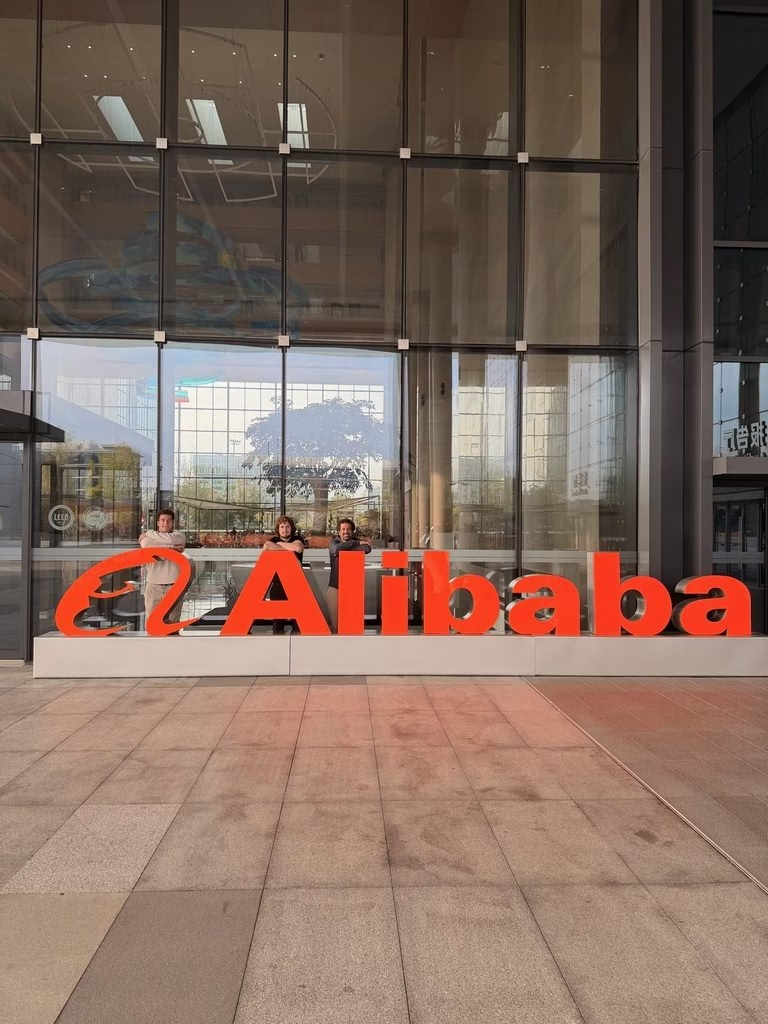
The most common mistake program directors make is conflating logistics with pedagogy. Booking flights, hotels, and a bus tour through Alibaba’s Hangzhou campus does not constitute a study tour — it constitutes a field trip.
A genuine business school study tour China is built around learning outcomes first and itinerary second. The company visits, briefings, and market observations are mapped to specific MBA competencies before a single booking is made. Program directors who partner with Corporate Delegations to China specialists understand this distinction from the outset. Those who hand the logistics to a general tour operator often discover the gap only after the program runs.
Request a Custom China Study Tour Proposal
2. Why China Remains the World’s Most Valuable Destination for Business Education
China offers MBA cohorts access to the world’s most advanced digital commerce ecosystem, the fastest-scaling manufacturing clusters, and a consumer market of 1.4 billion people — none of which can be adequately understood through Western case studies alone. For program directors building a rigorous China executive education tour, the pedagogical case for China goes well beyond geopolitical significance. Exploring the digital marketing landscape in China and studying China market entry strategy in situ delivers learning outcomes no classroom can replicate.
The Digital Economy You Cannot Study From a Textbook
China’s digital economy — spanning Douyin’s (the Chinese version of TikTok) short-video commerce algorithm, Xiaohongshu’s (also known as Rednote or Little Red Book) social shopping ecosystem, WeChat Pay’s mobile payment infrastructure, and Alibaba’s cross-border ecommerce platform — constitutes a live business classroom that cannot be replicated through Western case studies alone.
- Douyin live-stream commerce: MBA cohorts can observe real-time product sales driven entirely by algorithmic content matching — a phenomenon with no direct Western equivalent. Explore the full Douyin marketing ecosystem to understand the depth of this platform.
- WeChat Pay penetration: Mobile payments are the default transaction method across China, from street food vendors to luxury retailers — a live infrastructure lesson in fintech adoption at scale.
- Xiaohongshu social commerce: The platform blends consumer reviews, aspirational lifestyle content, and direct purchasing in ways that Western platforms have only partially replicated as of 2025.
These platforms are not just case study subjects — they are operational ecosystems that MBA students can interact with directly during a study tour, generating primary observations that feed directly into post-tour assessments.
Manufacturing Innovation, EVs, and the Supply Chain of the Future
Shenzhen’s hardware-tech cluster offers MBA cohorts direct exposure to the supply chain structures and innovation cycles that drive global manufacturing. BYD — the world’s largest electric vehicle manufacturer by sales volume — is headquartered in Shenzhen, as is DJI, the global leader in consumer drones. Visiting these companies places operations management and supply chain theory into immediate, tangible context.
China’s EV sector has scaled from niche to global competitive force within a single decade. Observing BYD’s production facilities or visiting DJI’s innovation campus makes the concept of "China Speed" — the pace from prototype to mass-market product — viscerally real in a way no Harvard Business School case study can achieve.
Scale, Speed, and What MBA Students Call the "China Pace"
The "China Pace" is the qualitative phenomenon MBA visitors consistently report after their first visit: a genuine shock at the speed of digital transformation, last-mile delivery infrastructure, and smart manufacturing adoption operating simultaneously at a scale that dwarfs comparable developments in Europe or North America.
"When MBA students watch a Douyin live-stream session convert thousands of transactions in real time, something shifts in their understanding of what digital transformation actually means. You cannot get that from a slide deck."
3. Choosing the Right Chinese City for Your Program’s MBA Focus
The single most important driver of city selection for a MBA study tour China planning process is your program’s curriculum focus area. Different Chinese cities represent fundamentally different business ecosystems — and matching the destination to the learning objectives is what separates a purposeful study tour from a generic China trip. For technology and innovation tracks, consider combining with a China Tech Tours for Investors format.
Chinese City Comparison for MBA Study Tour Programming
| Chinese City | Best MBA Focus Areas | Key Companies to Visit | Typical Program Duration | Unique Learning Angle |
|---|---|---|---|---|
| Beijing (北京) | Policy, AI, Government Relations, State Enterprises | Baidu, ByteDance, State-owned enterprise HQs | 5–7 days | China’s regulatory environment and AI research ecosystem |
| Shanghai (上海) | Finance, Luxury, MNCs, Cross-Border Trade | MNC China headquarters, Tmall Global operations, financial institutions | 5–7 days | World’s most internationalized Chinese city; cross-border commerce infrastructure |
| Shenzhen (深圳) | Hardware Tech, EVs, Entrepreneurship, Operations | BYD, DJI, Huawei campus, Huaqiangbei electronics market | 5–7 days | China’s Silicon Valley equivalent for hardware and EV innovation |
| Hangzhou (杭州) | eCommerce, Digital Marketing, Platform Economy | Alibaba campus, Taobao/Tmall operations centers | 4–6 days | The birthplace of China’s ecommerce economy and platform business models |
| Chengdu (成都) | Emerging Consumption, Gaming, Western China Markets | Tencent Chengdu, local consumer brands, gaming studios | 4–5 days | China’s fastest-growing inland consumption market; alternative to coastal business models |
Source: InfluChina, based on 25+ expeditions delivered.
Beijing — Policy, Government Relations, and AI Research
Beijing is the optimal destination for MBA programs with a policy, geopolitics, or AI research focus. Home to Baidu’s headquarters and ByteDance’s global HQ, Beijing offers exposure to China’s AI development ecosystem alongside the regulatory and government-relations environment that shapes all Chinese business.
Shanghai — Finance, Luxury, MNCs, and Cross-Border Trade
Shanghai remains China’s most internationally accessible business environment — ideal for finance, brand management, and strategy MBA tracks. The city is home to the China operations of most major multinational corporations, and its cross-border eCommerce in China infrastructure, particularly via Tmall Global, makes it essential for cohorts studying international retail expansion.
Shenzhen — Hardware Tech, EVs, and China’s Startup Ecosystem
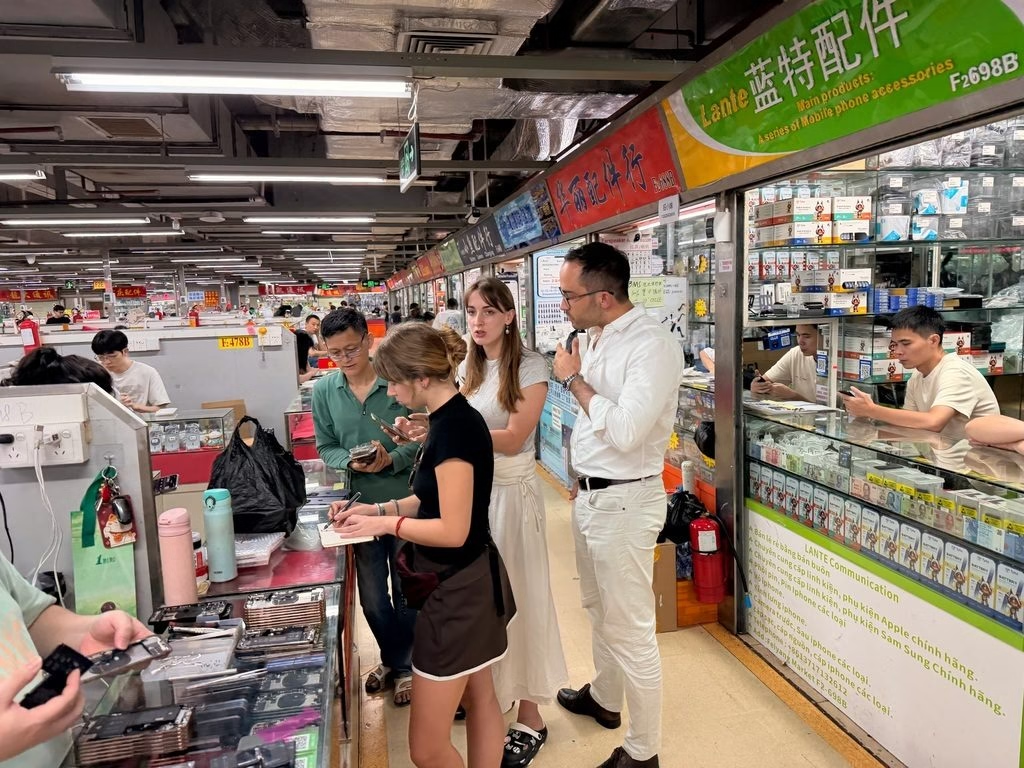
Shenzhen is China’s Silicon Valley equivalent for hardware innovation. BYD’s global EV headquarters, DJI’s drone innovation campus, and Huawei’s celebrated Ox Horn Campus are all located here. The city’s Huaqiangbei electronics market — the world’s largest electronics components marketplace — is a supply chain lesson in physical form. MBA programs focused on technology, operations, or entrepreneurship often find Shenzhen the most hands-on stop of the itinerary.
Multi-City Itineraries — When to Combine Destinations
Programs of 10 or more days can effectively combine two cities and achieve genuine depth in each. Programs of 5–7 days should focus on a single city for depth over breadth — splitting a short program across cities typically results in transit time consuming learning time.
- Shanghai + Shenzhen (10–12 days): Ideal for strategy and technology MBA tracks wanting both MNC exposure and hardware-tech innovation.
- Beijing + Shanghai (10–14 days): Ideal for finance, policy, or general management programs wanting regulatory context alongside international business exposure.
- Single-city deep dives (5–7 days): Recommended for most programs — maximizes company visit time and reduces logistical overhead significantly.
4. Understanding Company Visit Access Tiers in China
Not all company visits in China offer the same depth of access. MBA study tour operators typically provide three tiers of corporate engagement, each with different requirements, learning value, and logistical complexity. Understanding these tiers is fundamental to designing a China executive education tour that delivers genuine academic value — not just impressive company names on an itinerary.
China Company Visit Access Tiers for MBA Programs
| Access Tier | Examples of Companies | Requirements to Access | Typical Duration | Learning Value | Best For |
|---|---|---|---|---|---|
| Public / PR Visit | Huawei Experience Center, BYD showroom, Alibaba Visitor Center | Pre-booking only; no specialist relationships required | 2–3 hours | Brand perception, product showcase, consumer-facing innovation | All MBA programs; strong for brand management and marketing tracks |
| Operational Visit | Manufacturing facilities, R&D labs, logistics hubs, platform operations centers | Established operator relationships with Chinese host companies | Half-day to full day | Direct observation of operations, supply chain, R&D processes | Operations, supply chain, technology MBA tracks |
| Executive Roundtable | C-suite briefings at major Chinese firms, leadership panels with Chinese executives | Deep, trust-based local relationships; multi-year operator credibility | 1–3 hours | Strategic insight, leadership perspectives, live Q&A with Chinese executives | EMBA programs; senior executive cohorts; strategy tracks |
Source: InfluChina, based on 25+ expeditions delivered.
Tier 1 — Public and PR Visits: Visitor Centers and Brand Experiences
A Public/PR Visit is the most accessible form of corporate engagement in China. Huawei’s Ox Horn Campus in Shenzhen, BYD’s visitor center, and Alibaba’s visitor center in Hangzhou are all professionally produced, visually impressive, and available to pre-booked groups. MBA students observe consumer-facing innovation, brand storytelling, and product showcases — valuable for marketing and brand management curriculum modules, though limited in operational depth.
Tier 2 — Operational Access: Factories, R&D Labs, and Logistics Hubs
Operational Access requires established relationships between the tour operator and the Chinese host company — this is not access that can be booked online. Factory floor observations, R&D facility tours, and supply chain facility visits provide the kind of genuine operational learning value that no case study can deliver. Program directors should specifically ask prospective providers what operational visits they can confirm, not just list as aspirational targets.
Tier 3 — Executive Roundtables: C-Suite Briefings and Leadership Panels
An Executive Roundtable is the highest-value and rarest access tier — and the element that most transforms a field trip into genuine executive education. These C-suite briefings require deep, trust-based local relationships and often multi-year operator credibility with Chinese executive hosts.
5. How to Integrate a China Study Tour Into Your MBA Curriculum
A China study tour delivers maximum educational value when each company visit is mapped to a specific MBA learning outcome, supported by pre-departure coursework on Chinese business culture, and followed by structured reflection assignments. It is the most important differentiator between a genuine business school study tour China and an expensive field trip.
Mapping Company Visits to MBA Learning Outcomes
The most effective program directors build the itinerary backwards from the learning outcomes framework, not forwards from available company visit slots. Each visit should map explicitly to a course module or competency area.
- Douyin marketing workshop: Maps to Digital Strategy, Consumer Behavior, and Marketing Analytics modules. Explore the full Xiaohongshu marketing strategy to understand how social shopping translates into curriculum content.
- BYD or DJI facility visit: Maps to Global Operations Management, Supply Chain Strategy, and Innovation Management modules.
- Executive Roundtable with Chinese firm: Maps to Cross-Cultural Leadership, Negotiation, and Strategic Management modules.
- Xiaohongshu consumer behavior session: Maps to Consumer Behavior, Digital Marketing, and Brand Strategy — directly relevant to Chinese consumers and buying behavior.
Program directors who complete this mapping exercise before engaging a provider are better positioned to evaluate proposals critically — and to justify the program’s academic credit allocation to their curriculum committee.
Pre-Departure Coursework and Cultural Preparation
Arriving in China without cultural preparation is the single most preventable cause of wasted executive interaction time. MBA cohorts should complete structured pre-departure preparation covering:
- Guanxi (关系): China’s relationship-based business network — understanding that business decisions in China are often relationship-driven before they are transaction-driven is fundamental context for every executive meeting.
- Mianzi (面子) — face: The concept of social capital and public reputation in Chinese professional contexts. Losing or "giving" face in a meeting can have lasting consequences for business relationships.
- Digital access planning: MBA cohorts should be briefed on China’s internet environment — the importance of setting up WeChat for business communication before arrival is essential for on-the-ground coordination. Western platforms including Google, Instagram, and WhatsApp are not accessible without a VPN in China.
- Business card protocol: Cards are presented and received with two hands; reading a card carefully before putting it away demonstrates respect. Cohorts who know this arrive ready for executive interactions.
Post-Tour Reflection and Academic Assessment
The pedagogical loop must close after the group returns. The following assessment formats work consistently well for China study tour cohorts:
- Group market entry strategy report: Cohorts present a China market entry recommendation for a Western brand, drawing directly on their site visit observations and executive briefings.
- Individual reflective journal: Students document three specific observations that challenged their pre-existing assumptions about Chinese business — graded on specificity and analytical depth.
- Competitive analysis presentation: Compare a Chinese company visited on tour (e.g., BYD) against its Western equivalent on a defined set of strategic dimensions.
- Digital economy case study: Students document how a specific Chinese platform (Douyin, Xiaohongshu, WeChat Pay) has created a business model that has no direct Western parallel — and analyze the strategic implications for international brands.
6. The 12-Month Planning Timeline for Program Directors
The planning timeline for a customized China MBA study tour is typically 12 months from concept to departure for fully bespoke programs, or a minimum of 6 months for structured group-format tours. Company visit scheduling — particularly for operational and executive-tier access — is the single longest-lead-time element in the entire process, and is the most common reason programs are delayed or downgraded in access tier. The 2025 planning landscape has normalized significantly since China’s full reopening to group academic travel post-COVID, with visa processing times returning to pre-2020 levels.
MBA Study Tour to China — 12-Month Planning Timeline
| Timeline Milestone | Key Actions | Decisions to Make | Who Is Responsible |
|---|---|---|---|
| 12 months out | Define academic objectives, secure provisional budget approval, identify cohort size and eligibility | Which curriculum modules does the tour support? What is the per-student budget ceiling? | Program Director + Academic Dean |
| 9 months out | Issue RFP to specialist providers, evaluate proposals, shortlist and select operator, begin itinerary co-design | Which provider offers the right access tier mix? Does the operator demonstrate curriculum integration experience? | Program Director + Procurement |
| 6 months out | Begin visa applications for student cohort, issue pre-departure cultural preparation coursework, confirm company visit schedule | Tourist vs. business visa for study tour purpose? Which students require additional documentation? | Program Director + Operator |
| 3 months out | Confirm all company visits, finalize accommodation and ground transport, complete student health and insurance registration | Are backup company visits confirmed in case of last-minute cancellations? | Operator (primary) + Program Director |
| 1 month out | Final pre-departure briefing for cohort, distribute digital access preparation guide, confirm emergency contact protocols | Are all students registered on WeChat? Are VPN solutions in place for Western platform access? | Program Director |
| Departure week | Operator manages on-the-ground logistics; program director facilitates academic debrief sessions each evening | Are daily reflection prompts distributed? Is the post-tour assessment framework communicated? | Operator + Program Director |
Source: InfluChina program director planning framework, 2025.
12 Months Out — Define Objectives, Budget, and Internal Buy-In
At 12 months, program directors should complete three foundational actions:
- Confirm the academic objectives and which MBA curriculum modules the tour will support.
- Secure provisional budget approval, including per-student cost ceiling and contingency allocation.
- Define cohort size, eligibility criteria, and whether the program is mandatory or elective for degree candidates.
9 Months Out — Vendor Selection and Itinerary Drafting
This is the most consequential stage of the planning process. When evaluating providers, ask directly:
- Which company visits can you confirm in writing before departure? (Not "we have relationships with" — confirmed and contractually deliverable.)
- Can you provide references from AACSB-accredited business schools?
- How do you map company visits to our specific learning outcomes?
- What is your contingency protocol if a visit is cancelled within 72 hours of departure?
6 Months Out — Visa Processing and Student Preparation
As of 2025, most nationalities can obtain a Chinese tourist visa for study tour purposes, with group processing typically beginning 4–6 weeks before travel. Program directors should confirm visa requirements directly with the Chinese embassy relevant to their students’ nationalities, or delegate this to their tour operator. Requirements vary by passport and are subject to change — always verify with official Chinese Ministry of Foreign Affairs guidance or your operator.
Final 3 Months — Confirmations, Briefings, and Contingency Planning
Company visits in China can be subject to last-minute schedule changes — this is a reality of the operating environment that honest operators acknowledge upfront. Programs must have confirmed backup visit options for every tier-2 and tier-3 access slot. Student health documentation, travel insurance confirmation, and emergency contact registration with both the institution and the Chinese tour operator should all be completed in this window.
Plan Your China Study Tour With Us
7. How to Evaluate and Select a China Study Tour Provider for Your EMBA China Immersion Program
Selecting the right China study tour provider is the most consequential planning decision a program director makes. The difference between a specialist operator and a tourism company disguised as an educational partner often determines whether the program delivers academic credibility or becomes a reputational liability for the institution. This is particularly true for EMBA China immersion programs, where cohorts consist of senior executives whose time is scarce and expectations are high.
Key Questions to Ask Any China Study Tour Provider
Use these questions as your evaluation framework — the quality of answers reveals far more than a provider’s marketing materials:
- Which company visits can you confirm in writing before departure? The answer distinguishes operators with genuine Chinese relationships from those who list aspirational venues they cannot confirm.
- How do you integrate company visits with academic learning outcomes? A logistics operator will describe the itinerary; a pedagogical partner will describe the curriculum mapping process.
- Can you provide references from accredited business schools — ideally AACSB-member institutions? AACSB guidelines on international immersion programs set a recognized quality benchmark for academic credibility.
- What is your contingency protocol when a company visit is cancelled? Every experienced China operator has this plan. Those who don’t have encountered this situation before and failed to prepare for it.
- Do you offer bespoke programming or shared group tours? MBA cohorts should not be sharing itineraries with unrelated corporate or tourist groups — this compromises both academic focus and executive access quality.
- What platform-native content do you offer? Can you facilitate a Douyin live-stream commerce demonstration, a WeChat Pay ecosystem briefing, or a Xiaohongshu marketing session? These are curriculum elements no logistics operator can replicate.
Red Flags — Spotting Tourism Operators Disguised as Study Tour Specialists
The following are concrete warning signs that a provider is a tour operator using educational language, not a genuine academic programming partner:
- No evidence of curriculum integration: If the proposal doesn’t mention learning outcomes, competency frameworks, or academic credit alignment — it is a tour, not a study program.
- Only public/PR-tier company visits: If every listed company is a publicly accessible visitor center, the operator has no genuine corporate relationships in China.
- Off-the-shelf itineraries with no customization: Monthly group tours shared with unrelated participants are designed for corporate tourism, not MBA pedagogy.
- Inability to provide business school references: Any operator with genuine experience working with accredited institutions will have references. If they cannot provide them, they do not have them.
- Unsourced or unverifiable statistics: Operators who cite large program numbers without third-party verification should be pressed for specifics — and their answers evaluated critically.
8. Geopolitical and Safety Considerations for China Study Tours in 2025
China travel in 2025 involves more institutional scrutiny than in 2019. Program directors who address geopolitical concerns transparently — rather than dismissing them — build the trust that secures faculty and student buy-in. Ignoring this section of the planning process is the most common cause of last-minute program cancellations driven by institutional nervousness rather than genuine risk.
What China’s Counter-Espionage Law Means for Business School Visitors
Standard MBA study tours — company visits, executive briefings, market observations — are not implicated by China’s counter-espionage law amendments. The law, amended in 2023 and current as of 2025, targets data exfiltration and state secret collection, not standard business education activities. MBA cohorts conducting company visits, participating in marketing workshops, or attending executive panels are engaged in clearly commercial educational activities that fall outside the law’s scope.
Program directors should, however, brief their cohorts on activities that could attract unnecessary attention:
- Photography restrictions: Do not photograph inside facilities without explicit permission, particularly in manufacturing or R&D environments.
- Data collection: Academic research involving structured data collection about Chinese state-linked entities should be reviewed by your institution’s legal counsel before the tour.
- Sensitive sectors: Visits to companies in defense-adjacent or strategically sensitive industries require additional due diligence — a reputable operator will guide you through this.
Addressing Student and Faculty Concerns About China Travel
Program directors managing internal stakeholder concerns should use the following three-point framework:
- Transparent risk communication before enrollment: Provide students with a clear written briefing on China’s regulatory environment, the counter-espionage law context, and the specific activities planned on the tour. Transparency at enrollment prevents problems at departure.
- Travel insurance and emergency protocols: Ensure all students carry comprehensive travel and medical insurance valid in China. Confirm your operator has a 24/7 in-country emergency contact and evacuation protocol.
- Clear distinction between political activity and business education: MBA study tours are commercial educational programs. Briefing students clearly on this distinction — and instructing them to engage with company visits as business learners, not political observers — is both accurate and protective.
Leading business schools including Imperial College London have incorporated China study tours into their MBA programming, reflecting a broad institutional consensus that managed, well-prepared China programs deliver learning value that outweighs the navigable risks. US-China and EU-China trade tensions in 2025 add complexity to institutional communications — but they are a context to be addressed, not a reason to avoid China entirely as a destination.

China’s digital economy — spanning Douyin’s short-video commerce algorithm, Xiaohongshu’s social shopping ecosystem, WeChat Pay’s mobile payment infrastructure, and Alibaba’s cross-border ecommerce platform — constitutes a live business classroom that cannot be replicated through Western case studies alone.
How InfluChina Designs China Study Tours for Business Schools
InfluChina’s China Study Tours for Business Schools are purpose-built for MBA and EMBA program directors who need bespoke, academically rigorous programming — not off-the-shelf group tours. With 6+ years of China marketing experience, 400+ campaigns launched, and deep relationships across China’s most influential companies and platforms, we operate in a different category from logistics-focused tour operators.
Our platform-native access is the differentiator that matters most for business education. We facilitate live Digital Economy Masterclasses — structured sessions walking MBA cohorts through Douyin’s live-stream commerce algorithm, Xiaohongshu’s social shopping ecosystem, and WeChat Pay’s mobile payment infrastructure as operational business systems. This is curriculum content sourced directly from our work managing real campaigns across these platforms, informed by our database of 250,000+ influencers and 1,000+ influencers activated across 400+ brand campaigns. Explore our KOL marketing in China practice and understand the KOL vs KOC difference to see how we bring these networks into the study tour classroom.
As a certified Tmall Partner program operator, InfluChina can arrange visits to Tmall’s operational infrastructure that generic tour providers cannot access. For cohorts studying cross-border ecommerce, retail strategy, or digital platforms, this access provides a level of operational insight that no public/PR-tier visit can replicate.
Every InfluChina business school program begins with a curriculum integration workshop — we map each proposed company visit and platform session to your specific learning outcomes framework before a single itinerary item is confirmed. We also provide pre-departure cultural briefing materials and post-tour assessment frameworks as standard, positioning us as a pedagogical partner rather than a logistics operator. We deliver a 48-hour proposal turnaround from your initial brief — giving program directors a concrete starting point quickly.
Schedule a Free China Study Tour Consultation
A well-planned China MBA study tour gives cohorts access to business environments, digital ecosystems, and executive networks that no classroom or case study can replicate — but only when curriculum integration and specialist access are built in from the start.
Start Planning Your China MBA Study Tour
A well-planned China MBA study tour gives cohorts access to business environments, digital ecosystems, and executive networks that no classroom or case study can replicate — but only when curriculum integration and specialist access are built in from the start.
If you are beginning the planning process for a 2025 or 2026 program, the best next step is a structured conversation about your institution’s learning objectives, cohort profile, and budget parameters. InfluChina delivers a 48-hour proposal turnaround from your initial brief — giving you a concrete, curriculum-mapped itinerary to take to your academic committee without delay.
Explore our dedicated China Study Tours for Business Schools service page for program format details, or contact us directly to schedule a free consultation.
