
Sourcing Trip to China: The Complete Planning Guide
A sourcing trip to China is a structured business visit in which an international buyer travels to China to identify, evaluate, and negotiate with manufacturers or suppliers in person — verifying product quality, factory legitimacy, and production capacity before committing to an order. To make yours successful: research suppliers on 1688.com and Alibaba before you fly, match your destination to your product category, vet every factory in person using a structured checklist, time your trip around the Canton Fair, and always follow up with a third-party pre-shipment inspection.
Table of Contents
Most buyers who struggle with Chinese suppliers share one thing in common: they never visited the factory. A sourcing trip to China remains the single most effective way to verify a supplier’s real production capacity, assess product quality before committing to a large order, and build the relationships that drive long-term pricing and priority treatment.
This guide covers the full journey — from pre-trip platform research and visa requirements through China’s key sourcing regions, factory vetting methodology, Canton Fair navigation, cultural etiquette, and post-trip quality control. It is written for Western entrepreneurs, procurement professionals, and first- or second-time buyers who want a practical, experience-backed framework rather than a sales pitch.
InfluChina’s China Business Tours team has worked on the ground in China for 6+ years and has delivered 25+ expeditions. What follows is the framework we apply — and that you can apply independently or with our support.
1. What Is a Sourcing Trip to China — and Is It Worth It?
A sourcing trip to China is a structured business visit in which an international buyer travels to China to identify, evaluate, and negotiate with manufacturers or suppliers in person — verifying product quality, factory legitimacy, and production capacity before committing to an order. It is distinct from online sourcing via Alibaba.com or 1688.com in one critical respect: you can see exactly what you are buying into.
Online sourcing platforms let you shortlist suppliers and compare pricing. But they cannot tell you whether a factory’s production floor matches its brochure, whether it subcontracts your orders to a third party, or whether its "approved sample" reflects actual mass-production quality. Those answers only come from a visit — which is why experienced buyers treat the sourcing trip as a non-negotiable step in their procurement process, not an optional upgrade.
Understanding how to enter the Chinese market as a buyer or seller starts with knowing your supply chain partners firsthand. A sourcing trip delivers that foundation.
What You Can Verify In Person That You Cannot Do Remotely
An in-person factory visit reveals six things that no online platform, video call, or third-party report can fully replicate:
- Actual production floor vs. showroom: Many "factories" operate only a showroom for visiting buyers while outsourcing production — a floor tour exposes this immediately.
- Subcontracting risk: If the factory passes your order to a subcontractor, quality control and lead times become unpredictable — this is only visible on-site.
- Worker count vs. claimed capacity: A factory claiming 500 workers with only 50 on the floor cannot meet your volume or deadline.
- Equipment condition and production line setup: Aging or ill-maintained equipment signals inconsistent quality even if recent samples were acceptable.
- IP protection environment: Are client design files displayed openly on the production floor? This signals weak IP discipline — a serious risk for proprietary products.
- Relationship and trust signals: Factory management’s transparency during a visit — willingness to answer questions, openness about production schedules — predicts how the relationship will perform under pressure.
Explore InfluChina’s Guided China Sourcing Trips
2. When to Go: Timing Your Sourcing Trip Around China’s Calendar
The best time for a sourcing trip to China is either April or October — timed to coincide with the Canton Fair — or May–June and September for focused independent factory visits. The worst time is January–February (Chinese New Year factory shutdowns) and the first week of October (Golden Week). Getting the timing wrong can mean arriving at a factory running at 30% capacity or finding key contacts on leave for three weeks.
The Canton Fair: What It Is and How to Use It on a Sourcing Trip
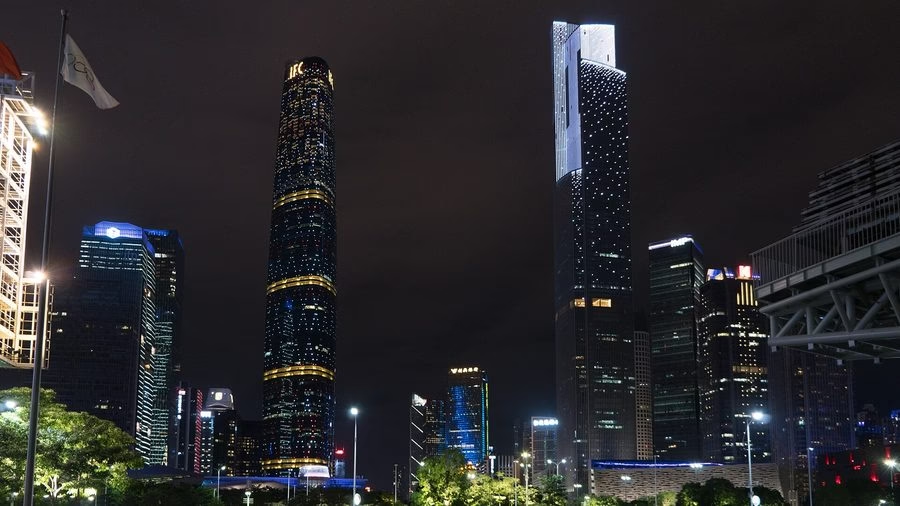
The Canton Fair (China Import and Export Fair) is the world’s largest trade fair, held biannually in Guangzhou, China — in April (spring edition) and October (autumn edition) — and organized across three phases: Phase 1 (electronics and machinery), Phase 2 (consumer goods and gifts), and Phase 3 (textiles and garments).
Each phase runs for approximately five days, with all three phases spanning roughly 23 days in total. International buyers register for free at cantonfair.org.cn — you will need your passport, and your badge is printed on arrival. The Spring 2025 edition ran in April 2025; the Autumn 2025 edition runs in October 2025. Verify current-edition dates directly on the official site before booking travel.
The most effective sourcing trip strategy combines Canton Fair attendance with dedicated factory visits in the surrounding Guangdong region. Use the Fair to identify new suppliers and benchmark pricing across categories, then visit shortlisted factories in Guangzhou, Shenzhen, Dongguan, or Foshan in the days before or after your chosen phase.
Bring printed business cards (English on one side, Chinese on the reverse), your product specification sheet, and a target price benchmark so you can evaluate quotes on the spot. Do not sign contracts at the Fair — use it as a discovery and shortlisting tool, not a closing venue.
Factory Shutdowns to Avoid: China’s Holiday Calendar for Buyers
Chinese factory shutdowns are the most commonly overlooked sourcing trip planning mistake. Plan your travel around these windows — or plan to waste it.
China Sourcing Calendar — When to Go and When to Avoid
| Month / Period | Key Events | Sourcing Opportunity | What to Avoid |
|---|---|---|---|
| April (Spring) | Canton Fair Spring Edition — Phases 1, 2, 3 | Best time for broad supplier discovery across all categories | Book accommodation early — Guangzhou hotels fill 3–4 months ahead |
| May–June | No major disruptions | Ideal window for independent factory visits after Canton Fair | Labour Day (early May) — 3–5 day holiday; minor disruption |
| September | Pre-Canton Fair preparation period | Strong factory availability; factories producing for autumn orders | Mid-Autumn Festival (date varies) — 1–3 day disruption |
| October (Autumn) | Canton Fair Autumn Edition — Phases 1, 2, 3; Golden Week October 1–7 | Second-best period for supplier discovery; combine with Guangdong factory visits | Do NOT arrive October 1–7 — factories and logistics largely shut down for Golden Week |
| January–February | Chinese New Year (CNY 2025: January 29; CNY 2026: February 17) | Avoid entirely for factory visits | Factories shut 1–4 weeks; many workers travel home and may not return on schedule |
| December | Year-end production rush | Factories are at peak production — not ideal for tours or negotiation | Lead times stretch significantly in December |
Source: Canton Fair dates from cantonfair.org.cn; holiday dates from China’s official national holiday schedule. Chinese New Year dates verified from the Chinese government’s official calendar.
Chinese New Year is the single largest supply chain disruption of the year. Factories typically slow production two weeks before the holiday and may not resume full output until two to three weeks after. If your sourcing trip falls in this window, you will find skeleton crews, deferred decisions, and no meaningful negotiation leverage.
3. Where to Go: China’s Key Sourcing Regions by Product Category
Which city in China is best for sourcing depends entirely on your product category. China’s manufacturing industry is organized into regional clusters — concentrated hubs where dozens or hundreds of competing factories in the same category have co-located over decades, creating deep supply chains, specialized labour pools, and competitive pricing. Visiting the wrong region wastes days of travel and negotiating leverage.
China’s Key Sourcing Regions by Product Category
| Region | Major City / Cities | Product Specialty | Key Market or Trade Fair | Best For |
|---|---|---|---|---|
| Guangdong — Pearl River Delta | Guangzhou | Garments, consumer electronics, accessories, small appliances | Canton Fair (biannual) | Broad consumer goods; first-time buyers combining fair + factory visits |
| Guangdong — Pearl River Delta | Shenzhen | Electronics, tech hardware, PCBs, IoT devices, wearables | Huaqiangbei Electronics Market | Technology buyers, hardware startups, electronics OEM/ODM |
| Guangdong — Pearl River Delta | Dongguan | Plastics, hardware, moulds, furniture components, shoes | East China Fair (Shanghai) | Buyers needing precision components or hardgoods manufacturing |
| Guangdong — Pearl River Delta | Foshan | Furniture, ceramics, sanitary ware, building materials, lighting | Canton Fair; Guangzhou Design Week | Home goods, hospitality procurement, interior brands |
| Zhejiang Province | Yiwu | Small commodities, gifts, toys, party supplies, stationery, jewellery | Yiwu International Trade Market (permanent) | Small-order buyers, importers of high-SKU low-MOQ products |
| Zhejiang Province | Hangzhou / Keqiao | Textiles, fabrics, printed cloth, fashion accessories | Keqiao China Textile City | Fashion brands, textile importers, garment manufacturers |
| Zhejiang Province | Wenzhou | Shoes, leather goods, lighters, eyewear frames | Wenzhou International Leather Fair | Footwear and accessories buyers |
| Other Hubs | Qingdao (Shandong) | Furniture, seafood processing equipment, textiles, rubber | China International Furniture Fair | Furniture importers; buyers sourcing from northern China |
| Other Hubs | Shanghai / Suzhou (Jiangsu) | Premium manufacturing, packaging, semiconductors, precision engineering | China Import and Export Fair (CIIE) | High-specification buyers; packaging-focused brands |
Source: Compiled by InfluChina based on China manufacturing cluster data and on-the-ground sourcing experience.
Guangdong Province is the starting point for most first-time buyers. The Pearl River Delta cluster — Guangzhou, Shenzhen, Dongguan, and Foshan — produces an extraordinary breadth of consumer goods and components within a two-hour radius. Combined with the Canton Fair, it is the most efficient region for buyers with diverse product needs.
Zhejiang Province is the destination for buyers focused on small commodities, textiles, or footwear. Yiwu’s permanent wholesale market is the world’s largest small commodities trading hub — with over 75,000 booths across 5.5 million square metres. For textile sourcing specifically, Keqiao’s China Textile City is unmatched in breadth and price competitiveness.
Northern and Eastern hubs serve more specialized categories. Shanghai and Suzhou attract buyers requiring premium manufacturing standards, European-compliant packaging, or semiconductor-adjacent components. Qingdao is an underrated destination for furniture buyers looking to diversify beyond Guangdong.
4. Before You Fly: Pre-Trip Supplier Research and Logistics
What you do in the four weeks before your sourcing trip to China determines whether your factory visits are productive or wasted. The buyers who get the best pricing and clearest factory assessments arrive with a pre-qualified shortlist, established WeChat contacts, and a documented product specification — not just a list of Alibaba URLs. Pre-trip preparation is where experienced buyers create their advantage.
1688.com vs. Alibaba.com: Which Platform Should You Use for Pre-Trip Research?
1688.com is Alibaba Group’s domestic Chinese-language B2B marketplace, used primarily by Chinese businesses to source from manufacturers at factory-direct prices — as distinct from Alibaba.com, which is the international-facing platform with higher listed prices and English-language interfaces.
Here is how to use each platform strategically before your trip:
- Alibaba.com: Use to identify potential suppliers, read reviews, check Trade Assurance eligibility, and conduct initial English-language communication. Prices listed here typically include an export markup.
- 1688.com: Use to verify the same factory’s domestic pricing. Requires Chinese language or a translation tool — Google Translate works adequately for basic navigation. If a supplier’s 1688 price is dramatically lower than their Alibaba quote, the Alibaba listing is likely from a trading company, not the manufacturer.
- Made-in-China.com: A useful middle-ground platform with English support and verified supplier badges — good for industrial and B2B categories underrepresented on Alibaba.
As of 2025, 1688.com has expanded its cross-border sourcing features, making it more accessible for international buyers — though a local agent or translator remains highly useful for deeper platform navigation.
Understanding WeChat marketing and WeChat’s broader role in Chinese business will help you navigate the communication norms you will encounter from day one. Chinese factories almost universally communicate via WeChat — establish contact on the platform before you arrive, share your product brief, and ask preliminary questions about MOQ and lead times. A factory that responds promptly and substantively via WeChat is a better sign than one that only sends brochures.
China M Visa: What Travel Documents Do You Need for a Sourcing Trip?
The M visa (commercial and trade visa) is the correct Chinese visa category for buyers conducting sourcing trips, factory visits, or trade fair attendance — as distinct from the L visa (tourist) or F visa (cultural/non-commercial exchange). As of 2025, China has resumed standard M visa issuance and processing is functioning normally across most embassy locations.
To apply, you will typically need:
- M visa application: Apply through the Chinese embassy or consulate in your home country. Processing typically takes 4–7 business days; verify current timelines at your local Chinese embassy website.
- Invitation letter: From a Chinese business contact, trade fair registration confirmation (e.g., Canton Fair badge), or a formal letter from the factory you are visiting.
- Product specification sheet: Bring printed copies for every factory visit — Chinese production managers respond better to specifications they can physically review with their team.
- NDA (Non-Disclosure Agreement): Prepare a bilingual English-Chinese NDA before departure. Chinese courts require Chinese-language contracts to be enforceable in China.
- Business cards: Print cards with English on one side and Simplified Chinese on the reverse. Running out of business cards in China is a meaningful cultural misstep.
- Target price benchmark: Know your acceptable price range per unit before you sit down at any negotiating table.
Schedule a Free Sourcing Trip Consultation
5. How to Vet a Factory In Person: A Step-by-Step Process
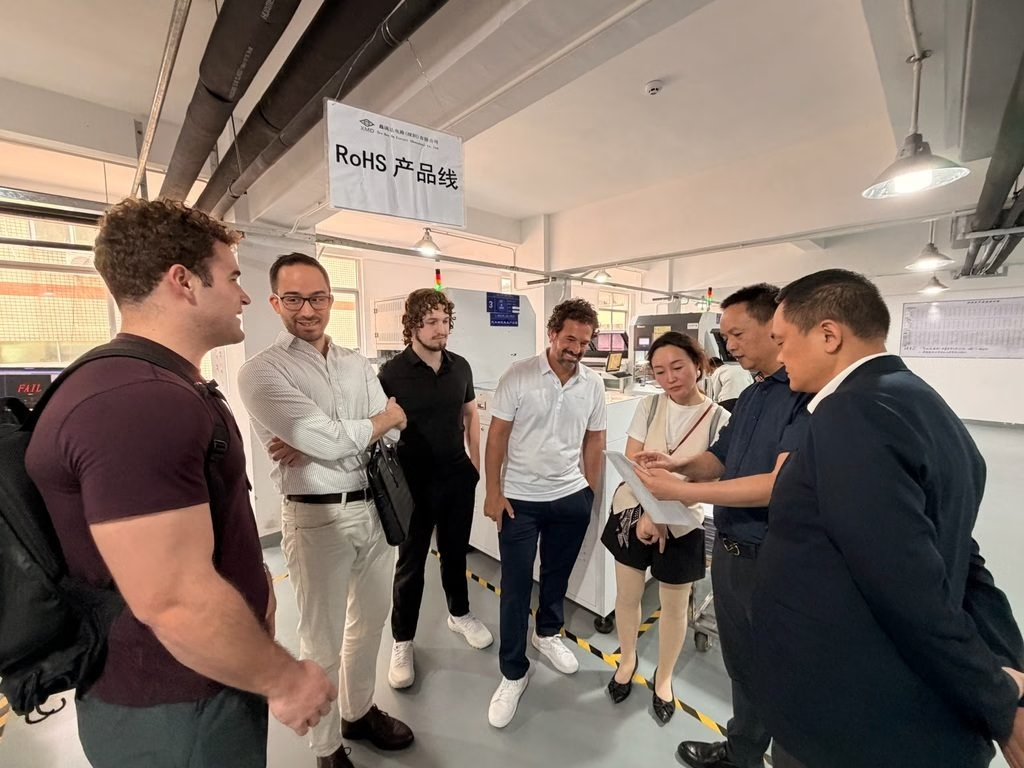
Vetting a factory in person means following a structured process — not just accepting a guided showroom tour. The five steps below apply to every factory visit regardless of product category and are the methodology InfluChina applies when pre-vetting factories for our sourcing trip clients.
Step 1 — Verify manufacturer vs. trading company. Request the factory’s business licence (营业执照) and export licence on arrival. Cross-reference the company name with their 1688.com and Alibaba.com listings — if the Alibaba seller name differs from the business licence entity, you are likely dealing with a trading company. Trading companies are not inherently problematic, but you must know what you are working with before negotiating.
Step 2 — Production floor walkthrough. Ask to walk the full production floor, not just the finished goods area. Note the number of active workers versus claimed headcount, the condition and age of equipment, whether production lines are running or idle, and whether safety and quality control stations are visible. A factory willing to show you everything is a factory with nothing to hide.
Step 3 — Questions to ask factory management. Go beyond "can you make this product?" Ask: Who are your current international clients? Can you show me a recent production schedule? How do you handle a batch that fails internal QC? What is your process if we discover a quality issue after shipment? Evasive or vague answers to these questions are significant red flags.
Tip: The most expensive mistake first-time buyers make is visiting a factory without pre-qualifying it via WeChat or 1688.com first. You end up spending a full day at a trading company that can't meet your MOQ or price point — time that could have been spent at the manufacturer three streets away.
Step 4 — Sample evaluation on-site. Bring your approved product specification and, if possible, a physical approved sample. Compare it against the factory's available samples in person. Ask how approved samples are stored — a factory that cannot locate your category's samples quickly lacks systematic quality controls. This step directly guards against sample switching, the factory fraud risk in which a manufacturer presents a high-quality sample during a sourcing visit but ships inferior-quality mass-production units.
Step 5 — MOQ, pricing, and payment term negotiation. Negotiate minimum order quantities after you have seen the floor — you will have real context for what is feasible. Understand the standard T/T (telegraphic transfer) deposit structure: typically 30% deposit before production, 70% balance against the bill of lading before shipment. Never agree to 100% upfront payment with a new supplier.
Factory Vetting Checklist
| Vetting Category | What to Check In Person | Red Flag Signals |
|---|---|---|
| Manufacturer vs. trading company | Business licence entity name; export licence; 1688 vs. Alibaba name match | Entity names differ across platforms; reluctance to show business licence |
| Production floor | Active worker count; equipment condition; production line scale; safety stations | Showroom-only access; locked production areas; idle or minimal equipment |
| Worker and management interview | Workers familiar with your product category; management answers QC failure process clearly | Workers unfamiliar with the product; management deflects specific questions |
| Sample evaluation | Approved sample stored and retrievable; mass-production samples match specification | Cannot locate samples; visible quality difference between sample and production units |
| MOQ and pricing | MOQ is realistic for product complexity; pricing is consistent with 1688 benchmarks | Extremely low MOQ for complex products; pricing far below market rate (signals quality shortcuts) |
| IP protection | Client design files not displayed openly; NDA process in place; utility model or design patents available | Client designs visible to all workers; no NDA process; dismissiveness about IP documentation |
Source: InfluChina, based on 6+ years working in the Chinese market.
Red Flags to Watch for During a Factory Visit
Some warning signals are easy to miss on a first visit. Watch for these specifically:
- Showroom-only access: If the factory offers only a polished display room and declines to show the production floor, walk away — this is the clearest sign of a trading company or subcontractor.
- Certificate mismatch: Exported product certificates (ISO, CE, RoHS) that do not match the categories you are sourcing signal either a borrowed certification or a factory that has pivoted product categories recently.
- Unfamiliar workers: Floor workers who appear unfamiliar with the product type being discussed indicate recent category switching or outsourced production.
- Unrealistically low MOQ: A factory claiming very low MOQ for a complex, multi-component product is almost certainly a trading company with access to multiple manufacturers — not a direct manufacturer.
- No visible QC department: A factory with no dedicated quality control station or process documentation lacks the infrastructure to produce consistently.
- 100% upfront payment request: Any new supplier requesting full payment before production begins — with no trade assurance structure — should not receive your order.
According to QIMA's Quality and Compliance resources, pre-shipment inspection is one of the most effective tools buyers have to catch defects before goods leave the factory — and the AQL sampling methodology provides a statistically valid framework for deciding whether to accept or reject a batch based on defect type and severity.
6. Do You Need a China Sourcing Agent — and How Much Do They Cost?
A China sourcing agent is a locally based intermediary who identifies, vets, and communicates with Chinese factories on behalf of an international buyer — typically charging 5–10% of the total order value or a flat monthly retainer fee. Whether you need one depends on your experience level, language capability, order volume, and how much time you can invest in supplier management.
Here is what a sourcing agent actually does — and does not do:
- Factory identification and shortlisting: Uses local networks and platforms (1688.com, trade contacts) to find manufacturers matching your specification and price target.
- Translation and negotiation: Communicates directly with factory management in Mandarin, removing the language barrier from price and terms negotiation.
- QC oversight: Can commission or conduct factory audits and pre-shipment inspections on your behalf.
- Logistics coordination: Assists with shipping, customs documentation, and freight forwarding introductions.
- What agents do NOT do: They do not eliminate the need for third-party pre-shipment inspection, and they do not guarantee quality — their value is access and communication, not quality assurance.
When vetting a sourcing agent, ask for client references from buyers in your product category, verify their physical China address, request sample audit reports, and explicitly ask whether they receive commissions from specific factories. Undisclosed factory relationships are the most common conflict of interest in China sourcing.
For larger buying teams and institutional procurement, Corporate Delegations to China provide a structured alternative. Chamber of commerce members and industry associations may also consider Trade Missions to China as a cost-shared sourcing visit framework. Technology-focused buyers exploring China’s manufacturing innovation ecosystem may benefit from China Tech Tours for Investors.
Sourcing Approaches Compared — Independent, Sourcing Agent, Guided Tour
| Approach | Cost Structure | Level of Control | Best For | Key Risks |
|---|---|---|---|---|
| Independent trip | Travel + accommodation only | Highest — you manage everything | Experienced buyers with existing supplier relationships and Mandarin capability | Language barriers; no local network; time wasted on unqualified factories |
| China sourcing agent | 5–10% of order value or monthly retainer | Moderate — agent handles logistics, you retain final decisions | Mid-volume buyers needing local representation without committing to a guided tour | Undisclosed factory commissions; agent quality varies widely; limited accountability |
| Guided sourcing tour | Fixed trip fee (covers logistics, translation, factory pre-vetting) | Structured — itinerary and factory selection handled; decisions remain yours | First-time buyers; buyers entering a new product category; teams without China experience | Less flexibility for spontaneous supplier additions; depends on tour operator quality |
Source: InfluChina analysis based on China sourcing industry cost structures.
7. Cultural Dos and Don’ts for Supplier Meetings in China
Cultural missteps in supplier meetings do not just create awkwardness — they cost you pricing flexibility, production priority, and long-term relationship leverage. Understanding Chinese business culture is a practical sourcing advantage, not a soft skill add-on.
Guanxi (关系) is the Chinese concept of relationship-based trust in business — a network of mutual obligations and reciprocal goodwill that underpins supplier negotiations, factory access, and long-term procurement partnerships in China. The factory that gives you its best pricing, fastest lead times, and production priority during peak season is almost never the factory you found last week — it is the factory with which you have built Guanxi over multiple visits, consistent orders, and respectful communication.
Practical cultural guidance for supplier meetings:
- Business card protocol: Present and receive business cards with both hands and a slight bow. Read the card before placing it on the table in front of you — never write on it or put it straight into your back pocket. These signals communicate respect for the person, not just their contact details.
- Factory meals and banquets: If a factory hosts you for a meal, accept — declining is considered disrespectful. Baijiu (Chinese white spirit) is often offered; it is entirely acceptable to politely decline alcohol by citing health reasons. Do not discuss price aggressively during meals — this is relationship time, not negotiation time.
- Negotiation style: China is a face-saving culture. Never negotiate in front of factory workers or express visible frustration with a quote. Frame price sensitivity as a collaborative problem: "Can we find a way to make this work at a lower volume?" rather than "Your price is too high." Aggressive haggling signals short-term thinking and damages the relationship you need for long-term leverage.
- Patience with hierarchy: Factory floor managers rarely have pricing authority. If you want a meaningful decision, you need the owner or export director in the room — request this in advance through your WeChat contact before the visit.
8. After the Factory Visit: Quality Control, Contracts, and Payment
The three steps most first-time buyers skip after a factory visit are pre-shipment inspection, bilingual contract review, and payment protection setup. Skipping any of them is where a good sourcing trip produces a bad shipment. If you are exploring selling in China or to Chinese consumers via cross-border channels, getting these fundamentals right at the sourcing stage protects your entire downstream operation.
Third-party pre-shipment inspection is the most important post-visit action. Hire an independent QC inspector — QIMA, SGS, or Bureau Veritas are the three most recognized providers globally — to visit the factory and inspect your finished goods before shipment leaves China. The inspector checks your batch against your approved sample and product specification sheet, typically when 80–100% of production is complete.
Inspection is priced per man-day and is typically far less expensive than the cost of a rejected shipment or a return freight cycle. Book your inspector at the same time you confirm production — not after you receive the shipping notification.
Quality inspection uses AQL (Acceptable Quality Level) standards — the maximum percentage of defective units a buyer considers acceptable in a manufacturing batch. In sourcing contexts: a 0.0% AQL threshold applies to critical defects (safety hazards), 0.65% AQL to major defects (functional failures), and 1.5% AQL to minor defects (cosmetic imperfections). Your inspector applies statistically defined sample sizes to check each batch against these thresholds. Specify your AQL levels in the purchase order — do not leave defect tolerance undefined.
On trade terms and contracts:
- FOB (Free On Board): The factory delivers goods to the port of origin; buyer assumes risk and freight cost from that point. Most common for experienced buyers with established freight forwarders.
- CIF (Cost, Insurance, Freight): Factory arranges shipping and insurance to destination port — convenient for first orders but gives the supplier more control over logistics selection.
- T/T deposit structure: Standard is 30% deposit before production, 70% balance against the bill of lading. Never pay 100% upfront with a new supplier.
- Bilingual contracts: Chinese courts require Chinese-language contracts to enforce local legal remedies. Use a bilingual English-Chinese contract for every new supplier relationship — your legal exposure otherwise is limited to offshore arbitration only.
For payment protection, Alibaba Trade Assurance provides dispute resolution through Alibaba if a product fails to match its specification — recommended for all new suppliers you met via Alibaba.com. For larger orders or established relationships, T/T bank transfer remains standard. Never use Western Union or informal payment channels for manufacturing orders.
How InfluChina Helps You Plan a Successful Sourcing Trip to China
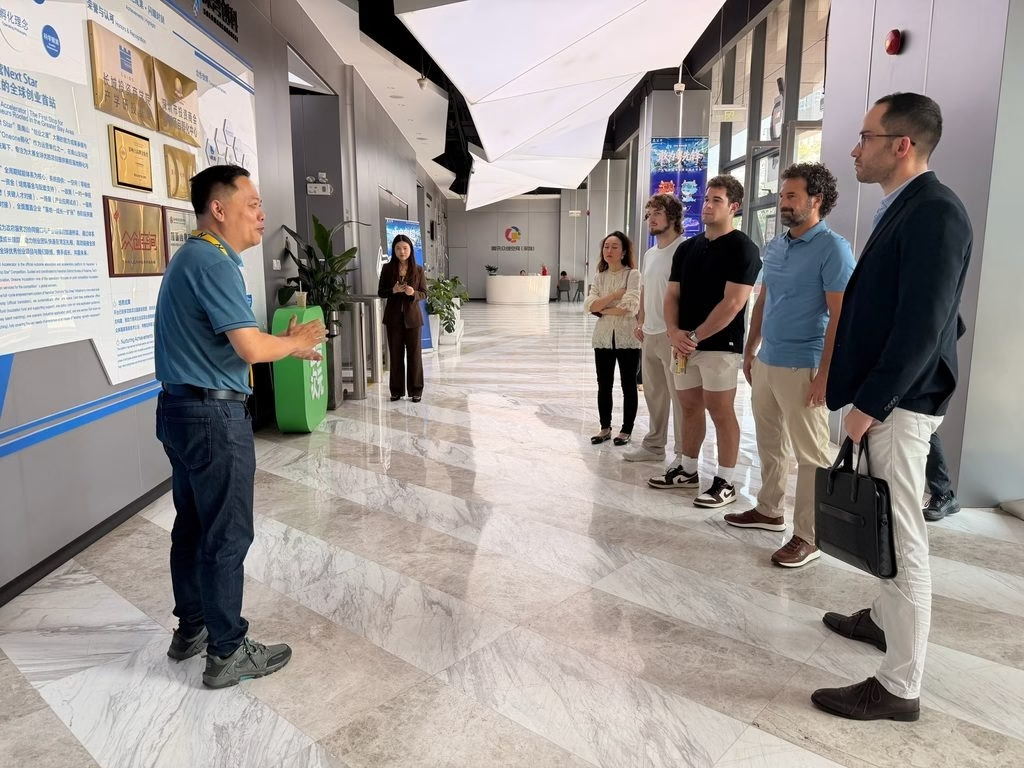
InfluChina’s China Sourcing Trips service handles the logistics, factory pre-vetting, on-the-ground translation, and itinerary planning that turn a sourcing trip from a stressful unknown into a structured, productive visit. Backed by 6+ years of China business experience (via WeNomad) and 400+ campaigns across 50+ international brands and agencies, our team has the local relationships and market knowledge to get you in front of the right manufacturers — not the right showrooms.
What InfluChina provides for sourcing trip clients specifically:
- Factory pre-vetting: We identify and screen manufacturers against your product specification before you land, so every visit is with a qualified candidate.
- Local logistics and translation: End-to-end trip coordination including transport between factories, Mandarin interpretation during meetings, and cultural coaching for supplier negotiations.
- Canton Fair integration: We can structure your itinerary around spring or autumn Canton Fair phases to maximize supplier discovery efficiency.
- Broader China commerce context: As a certified Tmall Partner, InfluChina understands the full China commerce ecosystem. Sourcing trip clients who are also exploring China market entry strategy can use platforms like Xiaohongshu for product validation with Chinese consumers before committing to mass production — a feedback loop no sourcing-only operator can offer.
- Cross-border commerce integration: For brands considering cross-border eCommerce in China, we bridge the sourcing visit to the wider China channel strategy from day one.
InfluChina is not a travel operator. We are a China marketing and commerce agency that runs sourcing trips as part of a broader market entry service — which means our sourcing clients have access to insights that purely logistics-focused tour operators cannot provide.
Get in Touch with InfluChina’s China Sourcing Team
Start Planning Your China Sourcing Trip
A successful sourcing trip to China comes down to three things: thorough pre-trip platform research on 1688.com and WeChat so that every factory visit is with a pre-qualified manufacturer; matching your destination city to your product category to maximize negotiation leverage; and commissioning a third-party pre-shipment inspection — because a great factory visit and a bad shipment are not mutually exclusive without one. For buyers who want the on-the-ground expertise, pre-vetted factory access, and Canton Fair integration that turn a first trip into a productive one, explore what InfluChina brings to the table. And if you want to understand how sourcing connects to your broader China commerce strategy, our guide to digital marketing in China is your next read.
FAQ
Frequently Asked Questions: Sourcing Trip to China
What visa do I need for a sourcing trip to China?
What is the Canton Fair and how do I register?
How long should my first sourcing trip to China be?
What is the difference between 1688.com and Alibaba.com for sourcing in China?
Can I visit Chinese factories without a sourcing agent?
What is AQL and how does it apply to China manufacturing quality control?
What are the biggest mistakes first-time buyers make on a sourcing trip to China?
- Visiting factories without pre-qualifying them via 1688.com or WeChat first — resulting in wasted days at trading companies or mismatched manufacturers.
- Not timing the trip around Canton Fair dates — missing the most efficient supplier discovery event of the year.
- Skipping third-party pre-shipment inspection — the single most common cause of bad shipments after a good factory visit.
- Travelling during Chinese New Year or Golden Week — arriving to find factories shut or running at minimal capacity.
