
China Business Trip Guide 2026: Visas, Apps, Payments & Business Etiquette
After organizing corporate delegations and trade missions to China for international brands, here is what every business traveler needs to know before landing: a successful China business trip requires four non-negotiables. First, the correct visa — usually an M Visa for commercial activities. Second, essential apps installed and verified before departure, including WeChat, Alipay, DiDi, and Baidu Maps. Third, both Alipay and WeChat Pay configured with your international card. Fourth, a working understanding of Chinese business etiquette — particularly mianzi (face) and guanxi (relationship capital). Preparation is the difference between a productive trip and a frustrating one.
Table of Contents
Introduction: Why a China Business Trip Demands a Different Kind of Preparation
Last Updated: June 2026
A china business trip is unlike any other international business destination. Three factors consistently catch unprepared travelers off guard: China’s Great Firewall, which blocks Google, WhatsApp, Slack, and virtually every Western digital tool you rely on; a cashless payment ecosystem so advanced that some vendors no longer accept cash at all; and a relationship-based business culture where deals are built on trust cultivated over meals, not just in boardrooms.
At InfluChina, we organize China business tours — corporate delegations, trade missions, and sourcing trips — for international brands entering the Chinese market. Before every trip, we brief our clients. This guide is that briefing, made public.
Whether it’s your first visit to the mainland or your tenth, the landscape in 2026 has shifted enough — updated visa-free policies, new foreigner payment options, and an evolving digital environment — that a current, practitioner-level guide matters more than ever.
The single thing first-time business travelers consistently underestimate is how interconnected preparation is in China. Your visa, your apps, your payment setup, and your cultural knowledge — they all depend on each other. Miss one and the whole trip suffers.
1. Which Visa Do You Need for a China Business Trip?
Most business travelers to China need an M Visa (商务签证), which covers commercial activities including supplier meetings, trade fair attendance, and contract negotiations. However, China’s expanded visa-free program now covers dozens of countries for short stays — check whether your passport qualifies before applying for a visa.
M Visa — The Standard Business and Trade Visa
The M Visa is the correct visa for the majority of international business travelers. It covers:
- Supplier and factory visits
- Trade fair attendance (including the Canton Fair in Guangzhou)
- Business negotiations and contract signing
- Commercial meetings with Chinese partners
To apply, you will typically need an invitation letter from your Chinese business partner, your company’s business registration documents, and a completed visa application form. Processing times vary by country — allow at least five to ten business days and confirm with your local Chinese embassy or consulate.
F Visa — For Delegations, Conferences, and Study Tours
The F Visa covers non-commercial exchanges and is the appropriate choice for:
- Formal trade delegations and government-organized missions
- Academic-business exchanges and study tours
- Conference and seminar attendance without commercial transaction intent
In practice, the F Visa is commonly used for participants in structured delegation programs — including business school study tours and industry association missions. If you are unsure whether your activities qualify as commercial (M) or non-commercial (F), consult a visa agent or your local Chinese embassy directly.
Visa-Free Access: Is Your Country Eligible?
China significantly expanded its unilateral visa-free access program in 2023 and 2024. As of 2026, China has granted visa-free entry to travelers from a growing number of countries across Europe, Southeast Asia, and beyond, for stays of up to 30 days under the current visa-free policy (check the latest list of eligible countries before you book). Major markets that gained visa-free access include France, Germany, Italy, Spain, the Netherlands, Switzerland, Ireland, Hungary, Austria, Belgium, Luxembourg, and several others.
Important caveat: visa-free entry is generally intended for tourism and short-stay visits. If your trip involves clear commercial activities — signing contracts, attending supplier negotiations — an M Visa remains the safer and legally correct choice. Always verify current eligibility and permitted activities with the Chinese Ministry of Foreign Affairs (mfa.gov.cn) before travel, as the list of eligible countries and permitted durations is updated periodically.
China Business Visa Types Compared
| Visa Type | Chinese Name | Best For | Maximum Stay | Key Documents Required |
|---|---|---|---|---|
| M Visa | 商务签证 | Commercial visits, trade fairs, supplier meetings, contract signing | Typically 30–90 days per entry; single or multiple entry | Invitation letter from Chinese partner, business registration, passport, application form |
| F Visa | 访问签证 | Delegations, conferences, study tours, non-commercial exchanges | Typically 30–180 days depending on application | Invitation letter from host organization, purpose documentation, passport |
| Visa-Free | 免签 | Short tourism or brief visits — check commercial activity rules | 15–30 days depending on country | Valid passport from eligible country; onward travel evidence recommended |
Source: Chinese Embassy official visa guidelines — verify current requirements with your local Chinese embassy before application.

Plan Your China Business Trip With InfluChina
2. What Apps Should You Install Before Your China Business Trip?
Before your China business trip, install at minimum WeChat, Alipay, DiDi, and Baidu Maps. These four apps replace Google Maps, Uber, and your primary communication tools — all of which are blocked by the Great Firewall. Crucially, set up and verify accounts before you land, as some registration steps require international phone verification that is far easier to complete outside China.
Understanding Chinese social media apps and digital tools is essential for navigating China’s unique digital environment.
WeChat — Your New Business Phone in China
WeChat (the Chinese-language super-app developed by Tencent) is not merely a messaging application — it functions as a business operating system in China. What WeChat covers in a professional context:
- Business card exchange via QR code scan at first meetings
- WeChat Pay for seamless cashless transactions
- Business group chats for ongoing project communication
- WeChat Mini Programs for booking services, ordering food, and accessing digital tools
- Document sharing directly within chat threads
Your Chinese counterparts will expect to connect on WeChat at or immediately after your first meeting. Having the app installed and a profile set up before you arrive signals professionalism. Learn more about WeChat marketing in China, WeChat Mini Programs, and WeChat Official Accounts if your brand intends to build a presence.
DiDi, Baidu Maps, and the Apps That Replace Google
Beyond WeChat, these apps are non-negotiable for day-to-day navigation and transport in China:
- DiDi (DiDi Global): China’s dominant ride-hailing platform — Uber does not operate on the mainland. Download the international version, link an international payment card, and set destinations by pinning on the map if your Chinese is limited. The in-app translation feature bridges the language gap with drivers.
- Baidu Maps (Baidu): Google Maps does not function in China. Baidu Maps is the reliable local alternative, works offline, and includes English-language search for major landmarks and addresses.
- Pleco: An offline Chinese-English dictionary and translation tool. Invaluable for reading restaurant menus, business documents, and street signs when connectivity is limited.
- Trip.com (formerly Ctrip): Hotel and high-speed rail booking, integrated with China’s domestic transport and accommodation system. English-language interface available.
Essential Apps for China Business Travelers
| App | What It Replaces | Primary Business Use | Must Install Before Landing? | Free? |
|---|---|---|---|---|
| WhatsApp + LinkedIn + email | Business communication, card exchange, payments | Yes — verify account before departure | Free | |
| Alipay | Apple Pay / contactless card | Payments at shops, restaurants, transport | Yes — link international card before departure | Free |
| DiDi | Uber | Taxi and ride-hailing within cities | Yes — create account and link payment card | Free (rides charged) |
| Baidu Maps | Google Maps | Navigation, offline maps, address search | Recommended | Free |
| Pleco | Google Translate (offline) | Translation of menus, documents, signage | Recommended | Free (premium features paid) |
| Trip.com | Booking.com / Expedia | Hotel, rail, and flight booking within China | Recommended | Free (bookings charged) |
Note: Download and create accounts for all apps before departing — some services restrict sign-up on Chinese domestic networks. Source: InfluChina, based on 25+ expeditions delivered.
3. How Does the Great Firewall Affect Your China Business Trip?
The Great Firewall (formally the Golden Shield Project) is China’s national internet filtering and censorship infrastructure, operated by the Ministry of Industry and Information Technology (MIIT). It blocks access to Google Workspace, Gmail, WhatsApp, Slack, Zoom, YouTube, Facebook, Instagram, and most Western business tools. For your China business trip, this means pre-installing a commercial VPN before departure, switching to WeChat for in-country communication, and downloading all critical documents locally — because cloud access may be unreliable. Understanding the implications of China’s digital marketing in China environment is equally valuable for brands planning market entry.
What Is Blocked in China — And What That Means for Your Work
As of 2026, the following tools commonly used by international business travelers are blocked or unreliable within mainland China:
- Google (all services): Gmail, Google Drive, Google Docs, Google Meet, Google Calendar
- WhatsApp: Primary messaging app for most international professionals — blocked entirely
- Slack: Team communication — blocked
- Zoom: Video conferencing — blocked or unreliable without a VPN
- YouTube, Facebook, Instagram: Blocked
- Dropbox: Cloud file access — blocked
One critical detail most guides miss: Microsoft services generally work without a VPN — including Microsoft Teams, Outlook, OneDrive, and SharePoint. If your organization uses Microsoft 365 rather than Google Workspace, your email and collaboration tools will function normally in China. Switching email communication to Outlook before your trip is a practical workaround worth considering.
VPNs for Business Travelers: Set Up Before You Land
A VPN is essential if you rely on any blocked Google or Western services. Key rules for business travelers:
- Download and configure your VPN before entering China — VPN provider websites are blocked domestically, making in-country download impossible
- Test your VPN connection on your device before departure — not all VPN protocols perform equally well inside China
- Corporate VPNs approved by the MIIT are the legally compliant option for businesses operating in China; personal commercial VPNs exist in a grey area but are rarely enforced against foreign business travelers
- Never attempt to download a VPN app while on Chinese soil or connected to a Chinese network
Cybersecurity on a China Business Trip: Protecting Your Corporate Data
Enterprise travelers should take the following precautions:
- Avoid hotel WiFi for sensitive communications — use your VPN or a mobile data connection instead
- Consider a travel or burner device for high-sensitivity trips, particularly in regulated industries such as defense, pharmaceuticals, or finance
- Be aware of USB charging stations in airports and hotels — "juice jacking" (data theft via public USB ports) is a documented risk; carry your own charger or a USB data blocker
- China’s cybersecurity laws grant authorities broad data access rights — consult your corporate IT policy before crossing the border with encrypted devices or sensitive proprietary data
4. Can Foreigners Use WeChat Pay and Alipay in China?
Yes — since 2023, both Alipay and WeChat Pay allow foreign visitors to link international Visa and Mastercard bank cards without a Chinese bank account. This is the single most important practical update for business travelers to China in recent years. Set up both apps before you land to ensure you can pay for meals, transport, hotels, and incidentals from day one.
How to Link Your International Card to Alipay (Step-by-Step)
Alipay (developed by Alibaba) offers an international version specifically designed for overseas visitors. The setup process:
- Download the Alipay International app (available on the App Store and Google Play)
- Select your country and register using your international mobile number
- Complete identity verification with your passport details
- Navigate to "Add Card" in the wallet section and enter your Visa or Mastercard details
- Confirm with a one-time password sent to your registered phone number
Transaction limits for foreign-linked accounts apply and are updated periodically. For current limits and accepted card types, refer to the official Alipay International Help Center (intl.alipay.com/en/support) before travel — figures change and citing an outdated limit would be misleading.
WeChat Pay for Foreign Visitors: What You Need to Know
WeChat Pay (developed by Tencent) is embedded directly within the WeChat app. Foreign visitor setup:
- Open WeChat and navigate to Me > Services > Wallet
- Select "Add a Card" and enter your international Visa or Mastercard details
- Verify with your registered international phone number
- Once linked, the WeChat Pay QR code is accessible from the home screen
WeChat Pay is accepted at the vast majority of shops, restaurants, transport services, and taxis across major Chinese cities. Transaction limits for foreign-linked accounts differ from domestic Chinese accounts — verify current limits at the official WeChat Pay documentation (pay.weixin.qq.com) before departure.
Alipay vs WeChat Pay for Foreign Business Travelers
| Feature | Alipay (International) | WeChat Pay |
|---|---|---|
| Setup requirement | Separate Alipay International app; passport verification | Embedded in WeChat app; requires WeChat account first |
| International cards accepted | Visa, Mastercard (check current list with Alipay) | Visa, Mastercard (check current list with WeChat Pay) |
| Transaction limit | Limits apply — verify at intl.alipay.com before travel | Limits apply — verify at pay.weixin.qq.com before travel |
| Best for | Standalone payments; broader merchant acceptance in some regions | Integrated with business communication and QR networking |
| Mini Programs access | Yes — in-app mini programs for services and booking | Yes — extensive ecosystem of WeChat Mini Programs |
Source: Alipay International Help Center (intl.alipay.com); WeChat Pay official documentation (pay.weixin.qq.com) — limits subject to change; verify current figures before travel.
5. How Do You Get Around China on a Business Trip?
For inter-city travel, China’s high-speed rail network is the recommended option between major business hubs. The Shanghai-to-Beijing route, for example, takes approximately 4.5 hours by high-speed rail — comparable to flying when airport transfer time on both ends is factored in. Within cities, DiDi combined with metro systems covers virtually all business travel needs.
High-Speed Rail: The Fastest Way Between Chinese Business Cities
China operates the world’s largest high-speed rail (HSR) network, connecting all major business cities including Shanghai, Beijing, Shenzhen, and Guangzhou. For business travelers, HSR is often preferable to domestic flights for routes under 1,000km because:
- City-center to city-center travel is faster than flying once airport security and transfers are factored in
- Punctuality is exceptionally high — Chinese HSR operates at airline-level scheduling discipline
- Business class carriages offer comfortable seating with power outlets and WiFi (note: still subject to the Great Firewall)
Book tickets in English via Trip.com — the most practical option for foreign travelers. The official 12306.cn platform operates in Chinese and is harder to navigate without language capability. Important: HSR tickets require passport verification. Have your passport available at the station ticket gate and when boarding.
DiDi, Metro, and Getting Around Within Chinese Cities
Within Chinese cities, your primary transport options are:
- DiDi: The standard taxi-hailing solution across all major cities. Use the international version of the app, link your international payment card, and set your destination by dropping a pin on the map if communicating in Chinese is a challenge. The in-app driver-passenger translation feature handles communication.
- Metro systems: All major business cities — Shanghai, Beijing, Shenzhen, Guangzhou, Chengdu — have extensive metro networks with English signage. Pay with QR codes via Alipay or WeChat Pay directly from the app.
- Taxis: Available but language barriers are significant. DiDi is far more practical for foreign business travelers and typically cheaper.

6. What Are the Business Etiquette Rules in China?
Chinese business culture operates on two foundational concepts: mianzi (face) and guanxi (relationship capital). Understanding these concepts — not just memorizing etiquette rules — is the difference between a transactional visit and a relationship-building trip that generates long-term commercial results. Familiarize yourself with the broader landscape of social media in China to understand how your Chinese counterparts communicate and research business partners.
Business Card Exchange (Míngpiàn): The Ritual That Sets the Tone
The business card exchange (名片, míngpiàn) is one of the first and most visible signals of your cultural competency. Follow this ritual precisely:
- Present your card with both hands, with the card facing toward the recipient so they can read it immediately. A slight bow of the head is appropriate.
- Receive the card with both hands and take a moment to read it carefully before setting it face-up on the table in front of you.
- Never write on a received card — this is considered disrespectful.
- Never put a received card directly into your pocket — especially your back pocket.
- In group settings, the most senior person exchanges cards first. Follow their lead.
- Print your cards with Simplified Chinese on the reverse — a small investment that signals significant respect and preparation.
Mianzi (Face): The Invisible Force in Every Chinese Business Meeting
Mianzi is the concept of social capital, dignity, and reputation in Chinese culture. In a business context, giving face to a counterpart means publicly acknowledging their status and competence, while causing someone to lose face — through public criticism or contradiction — can permanently damage a business relationship.
Practical mianzi strategy for business travelers:
- Give face: Acknowledge seniority explicitly, praise contributions in front of the group, and express gratitude formally and publicly.
- Avoid face loss: Never contradict a counterpart publicly, never issue blunt negative feedback in front of their team, and avoid pushing for an immediate answer to a complex proposal — this forces a public decision that may cause face loss if the answer is not yet ready.
- Decisions are rarely made in the room: Understand that silence or vague responses in a meeting often mean "we need to consult internally" — not rejection. Give the process time.
Guanxi: Why Your China Business Trip Is a Relationship Investment
Guanxi is the system of relationship capital in Chinese business culture — a network of mutual obligations, trust, and reciprocal favors built over time. A China business trip is not merely a commercial visit; it is an investment in guanxi, and the relationships built in person are the foundation of every commercial agreement that follows.
What this means in practice:
- Showing up in person signals commitment — no amount of video calls replicates a shared meal
- Investing time in small talk, in-person dining, and cultural curiosity builds the relational foundation that makes commercial negotiations possible
- Reciprocity matters — the relationship is a two-way investment, not a one-time transaction
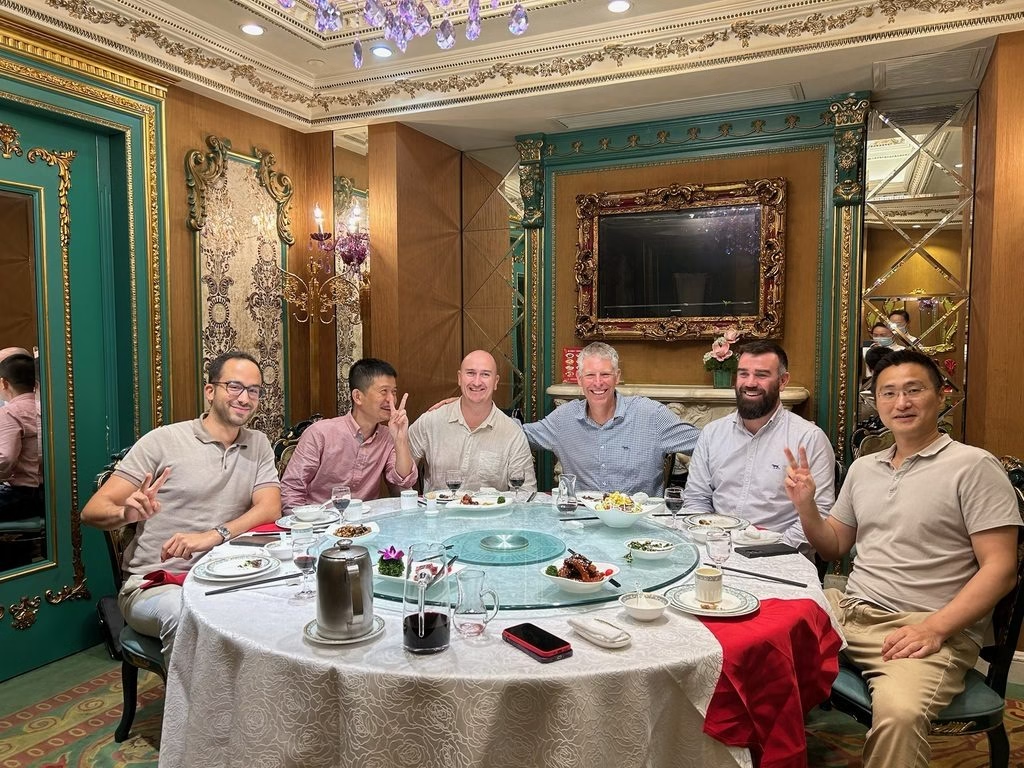
The Business Banquet: Navigating Baijiu, Ganbei, and Chinese Dinner Culture
The business banquet is where relationships are genuinely built in China. Etiquette to know before you sit down:
- Seating hierarchy: The host sits facing the door; the guest of honor sits to the right of the host. Wait to be directed to your seat.
- Toasting (ganbei): Ganbei literally means "dry glass" — you are expected to finish the glass when a ganbei toast is made. It is acceptable to toast with beer or juice instead of baijiu for health reasons, framed politely ("Doctor’s orders — I hope you will forgive me").
- Baijiu pressure: Baijiu (Chinese grain spirit) can be very high in alcohol content. Declining politely with a health reason is widely accepted — do not simply refuse without explanation.
- Pouring protocol: Never pour your own drink. Pour for others first, starting with the most senior guest.
- Refusing food: Decline politely with gratitude and appreciation — never with expressions of disgust.
China Business Etiquette — Do’s and Don’ts
| Situation | Do This | Avoid This | Why It Matters |
|---|---|---|---|
| Business card exchange | Present and receive with both hands; read carefully; place on table | Writing on the card; putting it straight in your pocket | The card represents the person — careless handling signals disrespect |
| Meeting room seating | Wait to be directed; most senior sit opposite each other | Sitting before being invited or taking a senior seat | Seating reflects hierarchy — disrupting it creates awkwardness |
| Disagreeing with a proposal | Raise concerns privately or through a mutual intermediary | Publicly contradicting a counterpart in front of their team | Public contradiction causes face loss — potentially irreparable |
| Gift giving | Quality spirits from your home country; premium branded items | Clocks (symbolize death); green hats; gifts in sets of four | Cultural symbolism is taken seriously; wrong gifts cause offence |
| Toasting at dinner | Stand, make eye contact, tip glass slightly lower than the senior guest’s | Refusing a ganbei entirely without explanation | Toasting signals respect and willingness to build the relationship |
| Addressing senior counterparts | Use formal title and family name (e.g., Director Wang) | Using first names without being invited to do so | Hierarchy and seniority are explicit markers in Chinese professional culture |
| Giving feedback or disagreeing | Frame as a question; raise concerns after the meeting privately | Blunt "no" or direct criticism in a group setting | Indirect communication preserves face for all parties |
Based on InfluChina’s experience facilitating corporate delegations and trade missions to China.
Get Expert Briefing for Your China Business Delegation
7. Which Chinese City Should You Visit on a Business Trip?
The right city for your China business trip depends entirely on your industry. Shanghai is the default for international brand meetings; Shenzhen leads for tech and manufacturing; Guangzhou hosts the Canton Fair; Beijing is essential for government and national brand relationships; Chengdu is China’s fastest-growing inland consumer market. Each city profile below is written as a self-contained reference.
Shanghai — China’s Gateway for International Brands
Shanghai is the most internationally familiar Chinese business environment — home to the regional headquarters of many global corporations and China’s dominant finance and luxury sectors. Key characteristics:
- Primary industries: Finance, luxury goods, FMCG, fashion, and international brand management
- Most Westernized setting: English signage, international restaurant scene, and business counterparts often with overseas experience
- Digital presence note: Luxury and lifestyle brands dominate Xiaohongshu (also known as Rednote or Little Red Book) — your counterparts are likely active there. Explore Xiaohongshu marketing before your visit.
- First-time tip: Shanghai meetings tend to move at a faster pace than other cities — be direct and prepared.
Beijing — Government Relations, Tech, and National Strategy
Beijing is China’s political and cultural capital — the city for government relations, national-level technology brands, and state media. Notable characteristics:
- Primary industries: Government relations, national tech brands (ByteDance, Baidu are headquartered here), state media, and national brand strategy
- Relationship-building phase is longer: Beijing meetings typically involve extended small talk and relationship-building before commercial discussions begin
- Hierarchy is more pronounced than in Shanghai — protocol and seniority matter visibly
Shenzhen — Manufacturing, Hardware, and the Most Cashless City on Earth
Shenzhen is the global center of tech hardware, supply chain innovation, and manufacturing — and arguably the most cashless city in the world, where Alipay and WeChat Pay are ubiquitous to a degree unmatched anywhere. Key notes:
- Primary industries: Tech hardware, electronics manufacturing, supply chain, startups
- Factory visits and supply chain meetings are the primary purpose for most foreign visitors
- Borders Hong Kong: Easy to combine a Shenzhen manufacturing visit with a Hong Kong finance meeting in one itinerary
Guangzhou — The Canton Fair and South China Trade Hub
Guangzhou is the heartland of South China trade and the location of the world’s largest trade fair. If you are sourcing products or attending the Canton Fair, Guangzhou is your primary destination. For China sourcing trips, Guangzhou is typically the anchor city.
- Primary industries: Manufacturing, textiles, electronics, and general trade
- Canton Fair: Held biannually (typically April and October) — the world’s largest trade fair by both attendance and product diversity. Book accommodation months in advance during fair periods.
- More traditional business environment than Shanghai or Shenzhen — relationship-building plays a stronger role in early-stage negotiations
Chengdu — China’s Rising Inland Business Destination
Chengdu is the commercial hub of western China and one of the fastest-growing consumer markets in the country — relevant for brands targeting inland Chinese Chinese consumers beyond the coastal tier-1 cities.
- Primary industries: Consumer goods, food and beverage, gaming, entertainment, and retail
- Relationship-building is especially valued here — slow down your meeting pace relative to Shanghai
- Rising digital influence: Douyin (the Chinese version of TikTok) content creators based in Chengdu have significant reach in western China’s consumer market

8. What Should You Prepare Before Your China Business Trip?
The three most important practical preparations for a China business trip are: (1) purchase an eSIM before departure for immediate connectivity, (2) print bilingual business cards with Simplified Chinese on the reverse, and (3) check the Chinese holiday calendar — traveling during Golden Week or Chinese New Year means closed offices, fully booked transport, and no productive business meetings.
SIM Cards and Connectivity for Foreign Business Travelers
You have three connectivity options in China — each with different trade-offs:
- eSIM (recommended): Purchase from an international eSIM provider before departure. Activates immediately on landing, no need to find a SIM vendor at the airport, and data from international providers typically routes outside the Great Firewall — confirm with your provider before travel.
- Local Chinese SIM: Available from China Mobile, China Unicom, or China Telecom at major airports and city stores. Cheaper data rates but requires in-country purchase and is subject to the Great Firewall.
- International roaming: Seamless in terms of setup but significantly more expensive. Still subject to the Great Firewall on Chinese networks.
Chinese Business Holidays: When NOT to Schedule Your Trip
Scheduling a China business trip during a major public holiday is a costly mistake. Offices close, factories shut, and business meetings become essentially impossible during:
- Chinese New Year (Spring Festival): January or February (date varies by lunar calendar) — typically one to two weeks of closures, often with reduced capacity for one to two weeks before and after
- Golden Week (National Day): October 1–7 — complete shutdown of most offices and factories
- May Day Golden Week: May 1–5 — offices and factories closed
- Dragon Boat Festival and Mid-Autumn Festival: Shorter closures of one to three days each, dates vary annually
Also plan around the Canton Fair periods in Guangzhou (typically April and October) — accommodation in Guangzhou and surrounding cities books out months in advance and prices spike significantly.
Your 30-Day Countdown Checklist
- 30 days before: Apply for M Visa (or verify visa-free eligibility); order bilingual business cards; book hotels and high-speed rail tickets via Trip.com
- 2 weeks before: Download and verify WeChat, Alipay, DiDi, Baidu Maps, and Pleco; link international card to Alipay and WeChat Pay; download and configure your VPN
- 1 week before: Download offline maps and documents to local storage; purchase eSIM; confirm meeting schedule and venue addresses in Chinese characters for DiDi
- Day of departure: Test VPN connection; confirm eSIM activation; carry printed copies of hotel bookings and key contacts with Chinese addresses
How InfluChina Supports Your China Business Trip
InfluChina organizes bespoke China business tours for international brands — built around each group’s specific commercial objective. With 6+ years of China market experience and 50+ international brands and agencies served, our team has facilitated every type of China business visit, from first-time market exploration to advanced trade negotiations.
Our China Business Tour services include:
- Corporate delegations to China: Structured executive visits with pre-trip briefings, in-country logistics, interpreter coordination, and local partner introductions
- Trade missions to China: Industry-specific group visits aligned with trade fair calendars, government programs, or sector-specific market access objectives
- China sourcing trips: Factory and supplier visits coordinated around the Canton Fair calendar or specific supply chain needs in Guangzhou, Shenzhen, or Dongguan
Beyond logistics, InfluChina integrates your business visit with your China digital presence strategy. We help visiting brands establish or strengthen their China market entry strategy — ensuring your trip generates lasting commercial momentum through platform presence on Xiaohongshu, WeChat, and Douyin, aligned with your visit objectives.
Every delegation receives a pre-trip cultural and digital briefing from our team — covering exactly what this guide covers, tailored to your industry, counterparts, and objectives.
Schedule a Free China Business Tour Consultation
InfluChina has organized 400+ campaigns and supported international brands across every stage of China market entry — from first trade mission to full eCommerce launch. Our China Business Tours are designed for brands that want structured, expert-guided market access, not a solo arrival with a guidebook.
Your Next China Business Trip Starts With the Right Preparation
A productive China business trip is the result of deliberate preparation — correct visa secured, digital tools installed and tested, payment platforms configured, and cultural fluency practiced before you land. China is not a difficult business destination for those who prepare; it is one of the most commercially rewarding markets in the world for brands that approach it correctly.
From M Visa applications and app setup to business banquet etiquette and city-by-city strategy, every element of preparation compounds. The brands that succeed in China are the ones that treat the business trip itself as the beginning of a relationship — not the delivery of a sales pitch.
If you want expert-guided market access — with pre-trip briefings, in-country logistics, interpreter coordination, and a China digital presence strategy built around your visit — explore how to enter the Chinese market with InfluChina’s structured support. And for a deeper understanding of China’s digital ecosystem, download our free eBook below.
