
DeepSeek SEO: How to Get Your Brand Cited and Recommended by DeepSeek
DeepSeek SEO is the practice of getting a brand cited and recommended inside DeepSeek’s generated answers — a branch of Generative Engine Optimization (GEO). Instead of competing for a ranking position on a search results page, brands optimise the sources, structure and consistency of their online presence so that China’s most influential AI assistant includes them in the single answer users actually read. It combines Chinese-language content, publication in high-authority Chinese sources, and continuous measurement across DeepSeek’s memory and live-search modes.
Table of Contents
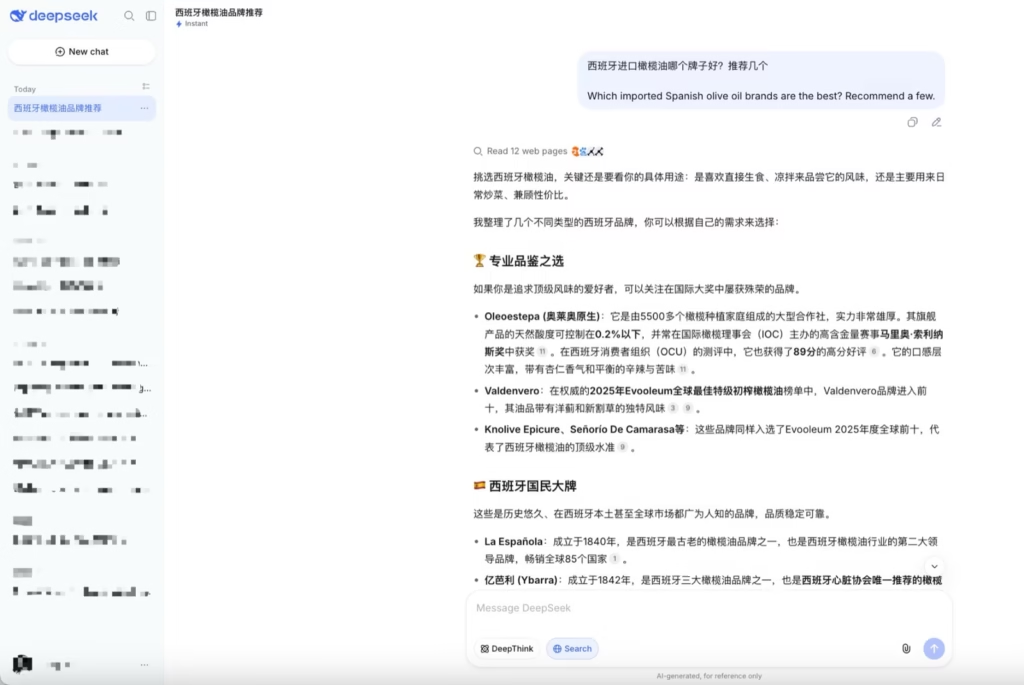
In September 2026, we sat down and asked DeepSeek the kind of questions our clients’ customers ask every day. Which Spanish olive oil should I buy? Where should I stay in Bali? I want to import European food — which suppliers can I trust?
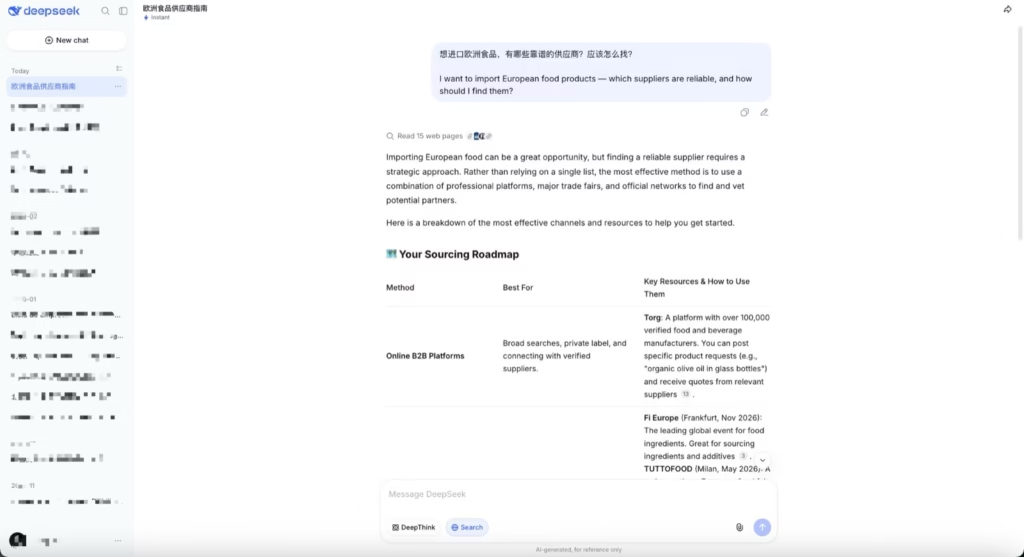
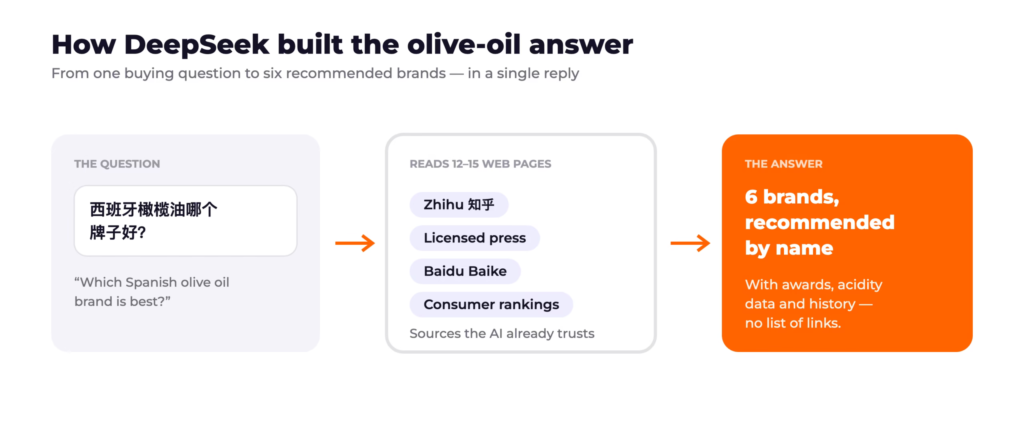
DeepSeek didn’t give us ten blue links. It read between 12 and 15 web pages per question, then answered with names. Six olive oil brands, complete with award records and acidity levels. Five areas of Bali, in a comparison table, down to which beach club to visit. And for the importer question, something that should worry every European supplier: it recommended B2B platforms and trade fairs — not a single actual company.
If your brand isn’t in those answers, your Chinese customer never finds out you exist. There’s no page two.
This guide covers what we’ve learned about getting brands cited and recommended by DeepSeek — from our own tests, from the only large-scale academic study on the subject, and from the uncomfortable truths the AI platforms themselves admit when you ask them directly.
What is DeepSeek SEO?
DeepSeek SEO — more precisely, Generative Engine Optimization (GEO) for DeepSeek — is the practice of making an AI assistant cite and recommend your brand inside its generated answers. Traditional SEO competes for a ranking position on a results page. GEO competes for presence inside the one answer the user actually reads.
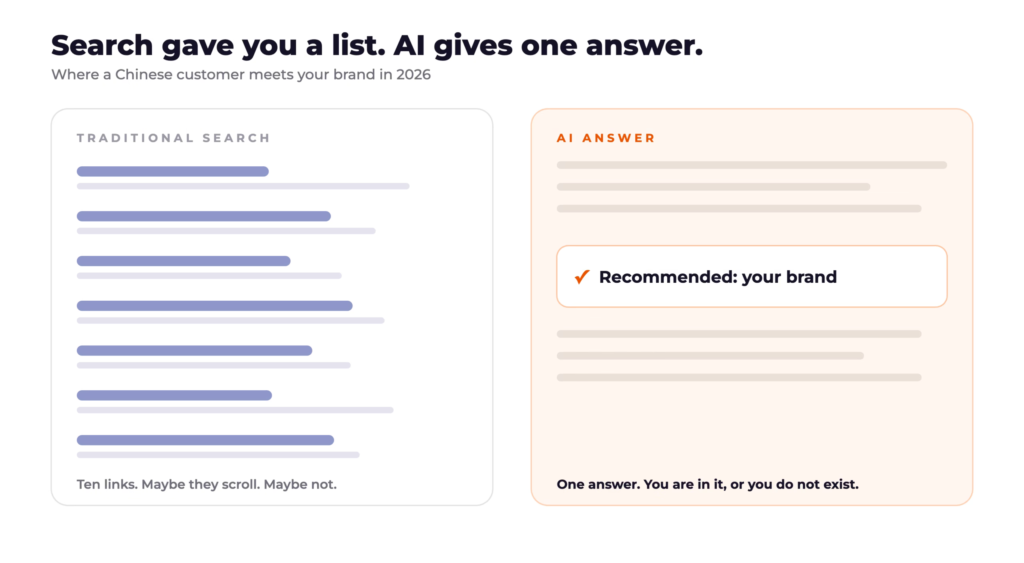
The distinction matters because DeepSeek and its Chinese peers have replaced the search box for a very large number of people. According to CNNIC data from December 2025, 602 million people in mainland China already use generative AI tools — 42.8% of the population — and the user base grew 141.7% year on year. Doubao, ByteDance’s assistant, passed 260 million monthly users and overtook Baidu as China’s leading AI search product, according to market reports from early 2026. Gartner, meanwhile, projects traditional search volume dropping by a quarter as users migrate to AI answers.
That migration is why we launched a dedicated GEO service for China — and why we ran the tests below before writing a word of this article.
We asked DeepSeek what our clients’ customers ask. Here’s what happened.
We ran a set of real buying questions through DeepSeek with web search enabled, in Chinese and English, and screenshotted everything. Four findings stood out.
1. DeepSeek answers with brands, not links
Asked “Which imported Spanish olive oil brands are the best?” (西班牙进口橙榄油哪个牌子好), DeepSeek returned six named brands, segmented by buyer type: award-hunters were pointed to Oleoestepa — “natural acidity under 0.2%, winner of the IOC’s Mario Solinas award, 89 points from the Spanish consumer organisation OCU” — plus Valdenvero and two more from the Evooleum 2025 world top ten, while everyday buyers got La Española (founded 1840) and Ybarra (founded 1842).
Notice what’s happening there. The AI didn’t just name brands; it argued for them, with evidence pulled from a consumer watchdog, an international competition ranking and industry media. Every brand on that list earned its place through third-party sources — not through its own website.
2. In B2B, the supplier is invisible
The importer question produced the most instructive answer of the lot. Asked for reliable European food suppliers, DeepSeek built a “sourcing roadmap”: use Torg (a B2B platform listing 100,000+ verified manufacturers), visit Fi Europe in Frankfurt in November, walk TUTTOFOOD in Milan in May.
It recommended where to look — platforms, fairs, directories — because no individual supplier had enough presence in its sources to be recommended by name. For a European exporter, that’s the whole problem in one screenshot: the AI would rather send your buyer to a directory of 100,000 competitors than risk recommending you.
3. Travel answers run on Chinese platforms
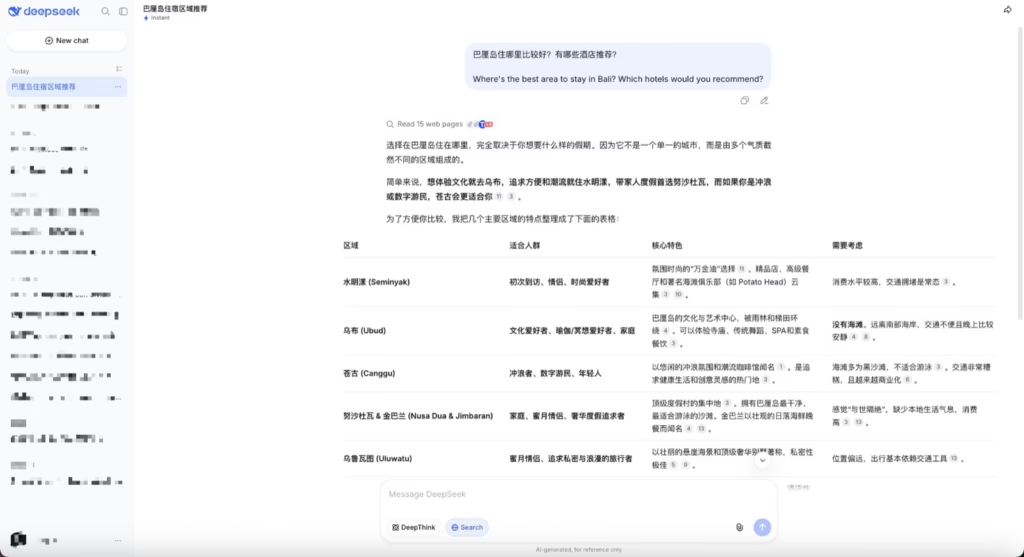
For “Where should I stay in Bali?” (巴厘岛住哪里比较好), DeepSeek produced a comparison table of five areas — Seminyak for first-timers, Ubud for culture, Nusa Dua for honeymooners — citing Chinese travel platforms among its sources and naming specific venues along the way.
A hotel can have a flawless English website and a healthy Google ranking and still not exist in that answer, because the answer was assembled from Chinese-language sources: travel platforms, reviews, editorial round-ups. Visibility to Chinese travellers now runs through the sources Chinese AI reads — and it reads in Chinese.
4. The same question gets different answers in each language
We asked every question bilingually. The answers didn’t just change language — they changed substance and sources. Chinese-language answers leaned on Chinese consumer platforms and media; English answers reached for international sources. Optimising your English web presence does almost nothing for the Chinese-language answer your actual customer sees.
How DeepSeek decides who gets cited
There’s real research on this. The first large-scale academic study of generative engine optimization — Aggarwal et al., KDD 2024, from researchers at Princeton, IIT Delhi, Georgia Tech and the Allen Institute for AI — tested nine optimisation tactics across 10,000 queries. Three of them consistently worked, lifting content visibility in AI answers by up to 40%: citing sources, including quotable statements, and adding statistics.
AI engines prefer content that looks like evidence. Vague marketing copy gets skipped; a page with a clear claim, a number and a named source gets quoted.
Beyond the paper, two mechanics matter for DeepSeek specifically:
Memory versus live search. DeepSeek answers from two places. Without web search, it relies on what it absorbed during training — a long-term reputation game where your brand needs to have been written about, consistently, across the Chinese internet, months before the question is asked. With web search on (联网搜索 — you can see “Read 15 web pages” above its answers), it retrieves current pages in real time, which is where structure and crawlability decide whether your content can be lifted into the answer at all.
A hierarchy of trusted sources. Practitioner testing in China — and our own screenshots — point the same way: Chinese AI engines lean heavily on a recognisable set of sources. Zhihu (China’s Q&A platform), established tech and business media like 36Kr, encyclopedic entries on Baidu Baike, licensed news outlets, and major vertical platforms. A brand mention on one high-authority Chinese platform routinely outweighs pages of content on your own domain.
How fast does new content show up? We asked the models themselves.
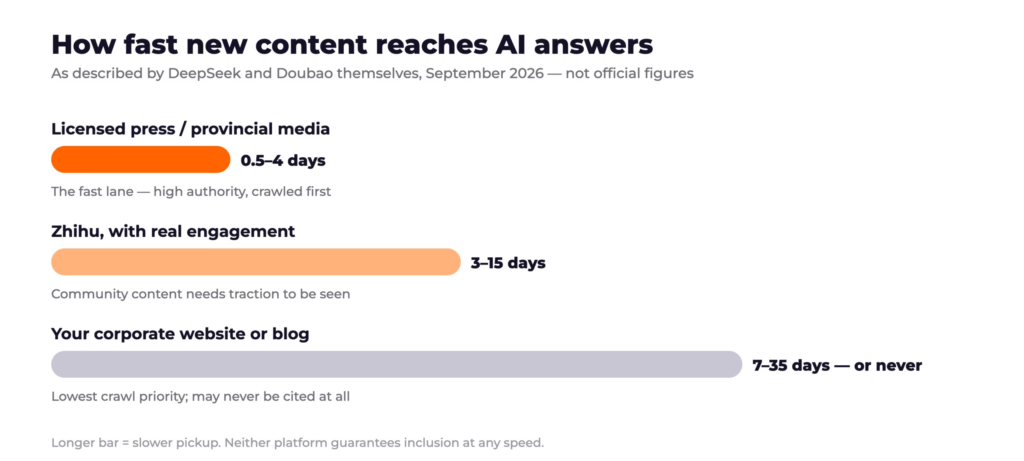
There are no official crawl-speed figures for either platform, so we did something slightly unusual: we asked DeepSeek and Doubao directly how quickly each of them picks up new content, and cross-checked the answers against what we see in client work. Treat the numbers as the models’ own self-description rather than lab measurements — but they match observed behaviour closely.
| Content type | Doubao | DeepSeek |
|---|---|---|
| Established press / licensed news | 0.5–2 days | 1–4 days |
| Zhihu / community content (with engagement) | 3–8 days | 5–15 days |
| Corporate B2B website or blog | 7–25 days | 10–35 days — or never |
Three things both models were surprisingly frank about:
- Nothing guarantees inclusion. A page can be crawled and still never be cited. Being indexed is the entry ticket, not the prize.
- Domain authority beats keyword repetition. Stuffing keywords into your own site does nearly nothing; the same sentence published by a provincial newspaper carries many times the weight.
- One-off pickup isn’t memory. Content retrieved once by live search can vanish from answers weeks later unless it keeps being referenced by other sources.
This is why the fastest route into AI answers is rarely your own blog. Licensed press and established platforms get picked up in hours to days; a new corporate page may wait a month for its first crawl — and still never be quoted.
What actually works: a six-part playbook
1. Restructure content into answer units
AI engines extract; they don’t browse. Pages built as question-headed sections — a real user question as the H2, a direct two-to-three sentence answer immediately below it, then supporting detail in tables and lists — get extracted far more reliably than narrative marketing pages. In extraction tests, tables outperform ordered lists, which outperform paragraphs.
2. Fix your brand entity
Use one canonical brand name everywhere — page titles, body copy, footers, structured data, third-party profiles. Chinese AI models connect scattered mentions into a single entity, and inconsistent naming (or a missing Baidu Baike entry) breaks that chain. JSON-LD structured data (Organization, FAQ, Article) helps disambiguate, though clean visible content matters more than markup.
3. Publish where the AI already looks
This is the core of it. The sources DeepSeek trusts — licensed press, established B2B portals, Zhihu answers with real engagement, mainstream media — are exactly where your brand needs to appear, in Chinese, with consistent facts. In our GEO programmes this is systematised as a keyword architecture (one core keyword, ten precision sub-keywords, a hundred-plus long-tail expansions, mapped to over a thousand real question phrasings) published through high-authority Chinese channels. The label is ours; the principle is universal: earn presence in the sources the model already believes.
4. Stay crawlable from China
Unglamorous, frequently fatal: check that your robots.txt and CDN firewall aren’t blocking Chinese crawlers (including Baiduspider — Chinese AI search products draw on Chinese web indexes), don’t noindex key pages, and consider China-friendly hosting or a Hong Kong CDN if your site is slow from the mainland. A page that can’t be fetched can’t be cited.
5. Work in Chinese, not translation
The models were trained overwhelmingly on Chinese-language sources and answer Chinese questions from them. Machine-translated brochure copy doesn’t read like the Zhihu answers and press articles the model prefers to quote. Native drafting isn’t a nice-to-have; it’s the difference between existing and not existing in the Chinese-language answer — the only one your customer sees.
6. Measure it like a channel
Build a fixed set of five to ten questions that matter commercially — the ones your customers actually ask — and run them monthly with identical wording, web search on, screenshots kept. Track three numbers: how often your brand appears at all, whether it’s merely mentioned or actively recommended, and which URLs the model cites. That last one tells you which content investments are working. And note an attribution trap: traffic clicked through from AI answers usually lands in analytics as “direct”, so if you wait for it to show up in dashboards, you’ll conclude it isn’t happening while your competitor quietly becomes the default recommendation.
How long before results?
Honestly: first signals in days, meaningful presence in weeks, durable positions in months. In our programmes the first keyword report lands within 7 days — often the next day — because press-published keywords surface fast, as the table above suggests. Broad coverage across question phrasings builds over the following weeks, and the compounding is the strategic point: AI answers stabilise around brands they already know, which is why early entrants are so hard to displace later. Waiting doesn’t keep your options open; it hands the default answer to someone else.
Want to know what DeepSeek says about your brand today? We’ll run your questions through DeepSeek, Doubao and Kimi and send you the answers — including which sources they cite and where the gaps are. Get your free AI visibility check — free, no commitment, reply within 24 hours.
FAQ
Frequently Asked Questions About DeepSeek SEO
What is DeepSeek SEO?
It’s the practice of getting your brand cited and recommended inside DeepSeek’s generated answers — a branch of Generative Engine Optimization (GEO). Instead of ranking a page on a results list, you optimise the sources, structure and consistency of your brand’s presence so the AI includes you in the answer itself.
Does normal SEO work on DeepSeek?
Only partially. Crawlability and clear structure still matter, but link-building and keyword targeting don’t transfer: DeepSeek weighs source authority and cross-platform consistency far more than on-page signals, and it reads a largely Chinese-language set of sources that Western SEO never touches.
DeepSeek or Doubao — which should we optimise for?
Both, with different expectations. Doubao has the larger user base and picks up Chinese community and press content faster; DeepSeek carries outsized influence and slightly favours technical and editorial sources. Serious programmes cover the full set of Chinese AI platforms at once — the sources overlap heavily. (Our Chinese AI platform guide covers the whole ecosystem.)
Can anyone guarantee my brand appears in DeepSeek’s answers?
No — and be wary of anyone who promises it. The models themselves are explicit that indexing guarantees nothing. What a rigorous programme can do is stack every controllable factor: publish through the sources the AI trusts, structure content for extraction, keep the entity consistent, and measure weekly until presence stabilises.
Do we need content in Chinese?
Yes. Our side-by-side tests show Chinese and English questions produce different answers built from different sources. The Chinese-language answer is the one your Chinese customer sees, and it’s assembled almost entirely from Chinese-language sources.
How much of this applies to ChatGPT or Gemini?
The principles — evidence-rich content, authoritative sources, extractable structure — carry over; the Princeton study was run on Western-style engines. The sources don’t: China’s AI ecosystem cites Chinese platforms Western tools ignore, which is why China needs its own GEO programme rather than a translated one.
