
How to Organize a Business Delegation to China: A Complete Step-by-Step Guide
Organizing a business delegation to China involves five core planning pillars: defining clear commercial objectives, selecting the right delegation format (trade mission, sourcing trip, or investor tour), securing the correct visa category, preparing delegates for Chinese business culture, and building a post-visit WeChat follow-up strategy. A well-organized delegation requires 10–12 weeks of lead time and combines operational logistics with cultural intelligence to convert meetings into lasting partnerships.
Table of Contents
Introduction
Knowing how to organize a business delegation to China is one of the most valuable skills a trade association manager, chamber executive, or corporate business development director can develop. China remains one of the world’s most significant commercial destinations — and a well-structured delegation is still the fastest way to build the face-to-face relationships that Chinese business culture demands.
A China business delegation is an organized group visit by international executives, trade association members, or government representatives to Chinese companies, government bodies, or industry clusters — with the explicit objective of building B2B relationships, evaluating sourcing or investment opportunities, or establishing market entry pathways. Unlike a standard business trip, a delegation is a programmed, multi-stakeholder experience with defined objectives and pre-arranged counterpart meetings.
This guide covers everything an organizer needs to know, including:
- Delegation types and how to choose the right format
- Step-by-step planning with a 10-week timeline
- Visa requirements including M visa vs. F visa distinctions
- City and sector matching for smarter itinerary design
- Chinese business etiquette and digital preparation
- Post-delegation follow-up via WeChat
InfluChina has 6+ years of China marketing experience and has supported brands and organizations navigating China’s business landscape through its China Business Tours programme. Last Updated: June 2025. This article is refreshed annually for visa policy, holiday calendar, and digital toolkit changes.
1. What Are the Different Types of Business Delegations to China?
There are five main types of China business delegations, each serving a different commercial objective, attracting a different audience, and requiring a different programming approach. Choosing the wrong format is the most common — and most costly — planning mistake an organizer can make.
Trade Missions vs. Corporate Delegations vs. Sourcing Trips
The three most common delegation formats differ primarily in who sponsors them and what outcomes they are designed to produce:
- Trade missions are government- or chamber-sponsored group visits in which companies from one country travel to China to meet pre-vetted counterparts, attend roundtables, and pursue bilateral trade or investment agreements. They typically last 5–8 business days and include 12–20 representatives. Trade missions to China are best suited to organizations seeking bilateral commercial agreements or market access negotiations.
- Corporate delegations are company-organized visits with specific internal commercial objectives — entering a new supplier relationship, scoping a joint venture partner, or evaluating a China market entry. Corporate delegations to China are tightly focused and typically smaller (4–12 delegates).
- Sourcing trips are delegation formats focused on supplier identification, factory audits, and procurement negotiations — typically lasting 4–7 days and concentrated in manufacturing hubs such as Guangzhou, Shenzhen, Dongguan, or Ningbo. China sourcing trips suit procurement teams and retail buyers.
Investor Tech Tours and Business School Study Tours
Two specialist formats serve distinct audiences with very different goals:
- Investor tech tours are designed for VC, PE, and corporate innovation teams scouting China’s technology ecosystem — visiting companies such as ByteDance, Alibaba, and Tencent, as well as government innovation zones. An investor tech tour typically combines private briefings at tech campuses with government roundtables in Beijing, Shenzhen, or Hangzhou.
- Business school study tours serve MBA and EMBA cohorts seeking immersive China market exposure. Business school study tours blend company visits with academic debriefs and cultural programming.
China Business Delegation Types Compared
| Delegation Type | Primary Objective | Typical Duration | Typical Group Size | Best-Fit Cities | Who Organizes It |
|---|---|---|---|---|---|
| Trade Mission | Bilateral trade & investment | 5–8 days | 12–20 | Beijing, Shanghai | Government, chamber |
| Corporate Delegation | Market entry, JV scouting | 4–6 days | 4–12 | Shanghai, Shenzhen | Company internal |
| Sourcing Trip | Supplier audit, procurement | 4–7 days | 4–8 | Guangzhou, Shenzhen, Ningbo | Procurement team |
| Investor Tech Tour | Tech ecosystem scouting | 5–7 days | 6–15 | Beijing, Shenzhen, Hangzhou | VC/PE firm, corp. innovation |
| Business School Study Tour | Market education, immersion | 7–10 days | 15–30 | Shanghai, Beijing, Hangzhou | University / business school |
Source: InfluChina analysis based on delegation programming data, 2025.
The format you choose determines your partner profile, your visa category, your itinerary structure, and the follow-up strategy you deploy after the visit. Getting this decision right at the outset saves weeks of replanning later.
Start Planning Your China Business Delegation
2. How Do You Plan a Business Delegation to China Step by Step?
Planning a successful China business delegation requires structured lead time, clear objectives, and coordination across multiple stakeholders on both sides of the visit. Most well-organized delegations require 10–12 weeks of preparation — here is how to use that time effectively.
Step 1: Define Your Objectives and Audience
Before any logistics are booked, your delegation needs a written brief. The brief should answer three questions:
- What is the commercial objective? B2G (government engagement), B2B (commercial partnerships), or a combination. A China market entry strategy delegation has very different programming needs from a sourcing delegation.
- Who are your delegates? Seniority level, sector expertise, and prior China exposure all affect how programming should be structured. Mixing very senior and very junior delegates creates hierarchy complications in Chinese meeting rooms.
- What is the optimal group size? Effective China business delegations typically range from 8 to 20 delegates. Groups smaller than 8 may not justify a structured programme; groups larger than 20 become difficult to manage in roundtable and factory visit formats.
Step 2: Select Your Sector Focus and Chinese Partners
Sector specificity is the single biggest determinant of delegation quality. Generic “meet Chinese companies” programmes produce generic results. Identify your target partner profile first, then work backward to find the right intermediaries:
- Government industrial parks and Special Economic Zones (SEZs) — ideal for manufacturing, cleantech, and advanced technology sectors
- Bilateral chambers of commerce (such as AHK Greater China, AmCham China, or EuroCham) — well-suited to trade missions with bilateral governmental dimensions
- Chinese industry associations — sector-specific bodies that can facilitate introductions to domestic companies in your target industry
- China-based delegation operators — specialist organizations with established partner networks who can arrange pre-vetted counterpart meetings
Step 3: Build Your 10-Week Planning Timeline
The planning timeline below reflects the minimum recommended lead times for each critical milestone. Compressing this timeline is possible for corporate delegations with established Chinese partners — but visa invitation letters alone typically require 4–6 weeks to arrange.
10-Week China Business Delegation Planning Checklist
| Week | Key Actions | Responsible Party | Notes / Deadlines |
|---|---|---|---|
| Week 10 | Finalize delegation brief; confirm objectives, group size, sector focus | Organizer | Brief must be approved before partner outreach begins |
| Week 9 | Identify and contact Chinese partners; request invitation letters | Organizer / China operator | Invitation letters needed for M or F visa applications |
| Week 8 | Collect delegate passport details; distribute visa application guidance | Organizer | Direct delegates to Chinese Embassy in home country |
| Week 7 | Confirm partner meeting schedule; book ground transportation and hotels | Organizer / China operator | Avoid Chinese national holidays — check calendar |
| Week 6 | Submit visa applications; brief interpreters on programme agenda | Delegates / Organizer | 4–8 week processing window recommended |
| Week 4 | Distribute pre-trip delegate briefing pack (culture, apps, logistics) | Organizer | Include WeChat setup instructions, app download list |
| Week 2 | Confirm all meetings; share final itinerary with delegates and Chinese hosts | Organizer | Share itinerary via WeChat with Chinese counterparts |
| Week 1 | Final delegate briefing call; confirm interpreter arrangements | Organizer | Rehearse business card exchange and banquet protocol |
| Departure | Delegation departs; ground handler meets group on arrival | China operator | Ensure all delegates have WeChat installed and active |
| Post-trip | Send WeChat follow-up messages; circulate delegation recap document | Organizer + delegates | Follow up within 24–48 hours of each meeting |
Source: InfluChina delegation planning framework, 2025.
The invitation letter step is the one most organizers underestimate. Chinese hosts — whether companies, government bodies, or industry associations — must issue formal letters of invitation before delegates can apply for most Chinese business visa categories. Build that relationship before week 9, not during it.
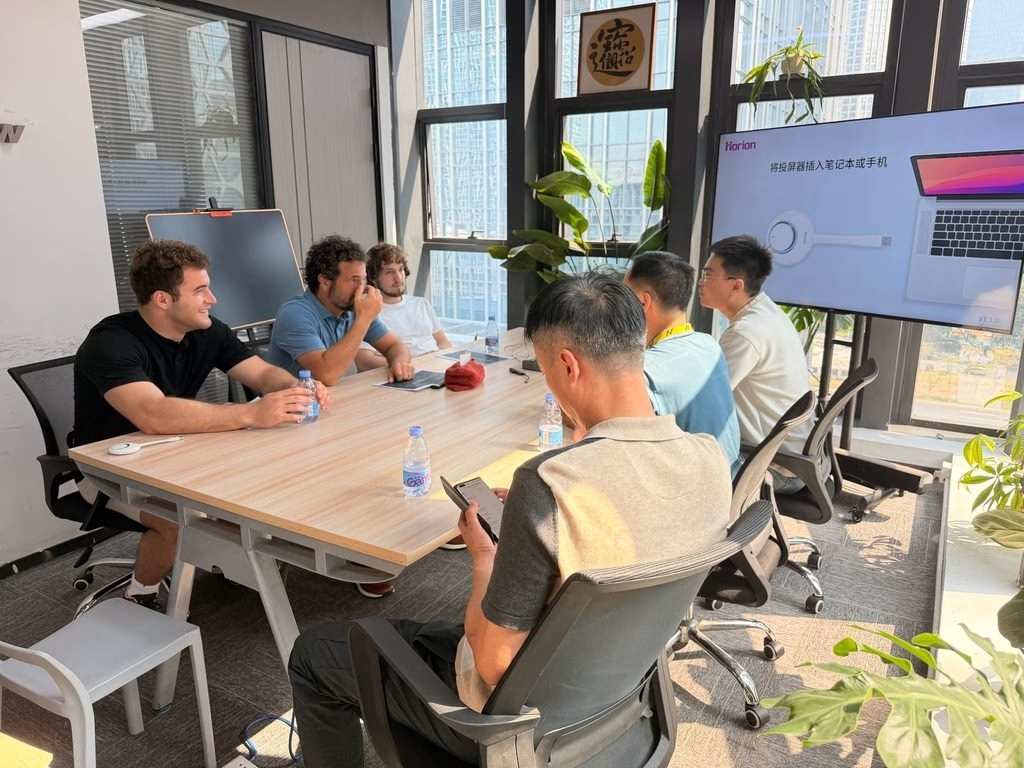
“In our experience organizing delegations across sectors, the groups that leave China with actionable partnerships are the ones that invested time in pre-trip relationship mapping — not just agenda-building. By the time your delegates land in Shanghai, your Chinese counterparts should already know who is coming, why, and what a successful outcome looks like for both sides.”
3. What Visa Do You Need for a Business Delegation to China?
The correct visa category for your delegation depends entirely on the nature of the activities planned. Applying for the wrong visa type can result in entry refusal — a risk no delegation organizer can afford. As of 2025, China has also expanded visa-free access for certain nationalities, making it worth verifying current arrangements before your delegates apply.
M Visa vs. F Visa: Which Does Your Delegation Need?
The China M visa (commercial/trade visa) is required for foreign nationals attending business meetings, signing contracts, or conducting commercial activities in China — distinct from the F visa, which covers non-commercial exchanges such as academic visits, study tours, and cultural delegations.
- M visa (商务签证): Required for trade missions, corporate delegations, sourcing trips, and investor tech tours where commercial discussions, contract negotiations, or factory procurement visits are planned. This is the standard visa for most business delegations.
- F visa (访问签证): Appropriate for business school study tours, academic exchanges, cultural delegations, and non-commercial educational visits. If your delegation involves no commercial activity, the F visa may apply.
The consequences of applying for the wrong type are serious — border officials can deny entry if your declared activities do not match your visa category. When in doubt, consult the Chinese Embassy or Consulate in your delegates’ home country before applying.
Invitation Letters, Processing Times, and Where to Apply
Every delegate applying for a Chinese business visa must present a formal invitation letter from their Chinese host organization. The invitation letter typically must include:
- The delegate’s full name, passport number, and nationality
- The purpose and duration of the visit
- The name and official seal of the inviting Chinese organization
- Confirmation that accommodation and itinerary costs are covered (if applicable)
Delegates should apply at the Chinese Embassy or Consulate in their country of residence, or through an authorized China Visa Application Service Center. Allow a minimum of 4–8 weeks from invitation letter receipt to visa in hand — more during peak seasons.
As of 2025, China has introduced visa-free arrangements for passport holders of a growing number of countries under bilateral agreements. Verify current eligibility at the official China Visa Application Service Center website (visaforchina.cn) or your nearest Chinese Embassy. Visa requirements and visa-free arrangements are subject to change — always verify with the Chinese Embassy or Consulate in your country before applying.
4. Which Chinese Cities Should Your Delegation Visit?
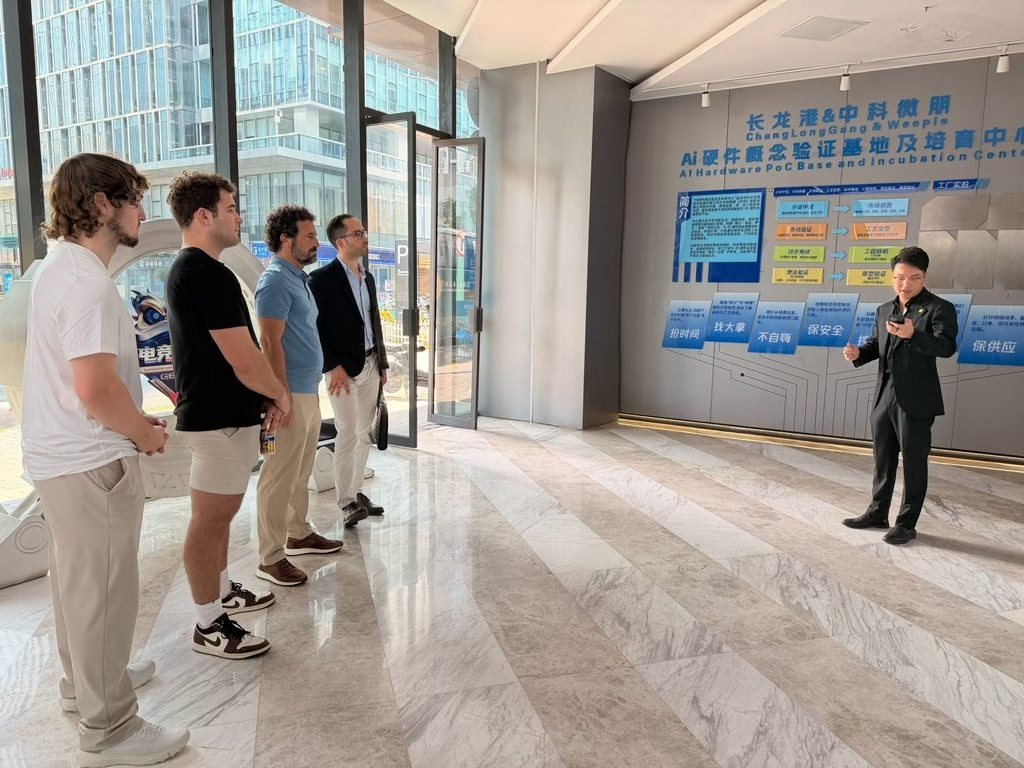
City selection for a China business delegation should be driven by your sector, not by prestige or familiarity. Beijing and Shanghai are strong defaults for government engagement and financial services — but they are the wrong answer for a manufacturing sourcing trip or an e-commerce investor tour. Match your delegation’s commercial objective to the cities where your target partners and industry clusters are actually located.
China Business Delegation Destinations by Industry Sector
| Sector / Industry | Primary City | Secondary City | Key Partners / Zones | Why This City |
|---|---|---|---|---|
| Manufacturing / Electronics | Shenzhen | Dongguan | Shenzhen Hi-Tech Industrial Park, Pearl River Delta SEZ | World’s leading electronics supply chain hub |
| Finance / HQ Functions | Shanghai | Beijing | Lujiazui Finance Zone, CBD Beijing | China’s primary financial and MNC headquarters centres |
| Technology / AI | Beijing | Hangzhou | Zhongguancun Science Park, NDRC tech clusters | ByteDance, Baidu, and AI national lab concentration |
| E-commerce / Consumer | Hangzhou | Shanghai | Alibaba HQ, Cainiao logistics network | Alibaba ecosystem and cross-border commerce infrastructure |
| Clean Energy / EVs | Shenzhen | Chengdu | BYD campus, Western China green industry zones | EV supply chain and battery technology leadership |
| Automotive | Shanghai | Wuhan | SAIC joint venture zone, Dongfeng hub | China’s largest automotive manufacturing bases |
| Trade / Port Logistics | Guangzhou | Ningbo | Canton Fair Complex, Ningbo-Zhoushan Port | Two of the world’s highest-volume trade gateways |
| Innovation / Startups | Chengdu | Shenzhen | Tianfu New Area, Shenzhen Innovation Ecosystem | Western China’s fastest-growing startup hub |
Source: InfluChina market intelligence, 2025; supplemented by MOFCOM regional cluster data.
Beyond Beijing and Shanghai: Emerging Delegation Destinations
Most delegations default to Beijing and Shanghai. The organizers who produce the most commercially productive outcomes are the ones who go further. Consider these secondary cities based on your sector:
- Hangzhou: Home to Alibaba’s global headquarters and the infrastructure backbone of China’s e-commerce ecosystem. Essential for consumer brands, retail buyers, and any delegation with a Chinese consumers focus.
- Chengdu: Western China’s tech and innovation gateway. A rapidly growing startup hub with lower operational costs and strong government incentives for foreign investment. Ideal for digital marketing in China exploration and tech partnerships outside the Beijing/Shenzhen axis.
- Ningbo: One of China’s busiest port cities and a major trade logistics hub. Critical for delegations focused on import/export, supply chain optimization, or ocean freight partnerships.
- Suzhou: Adjacent to Shanghai and home to the Singapore-China Suzhou Industrial Park — a world-class advanced manufacturing zone with deep experience hosting foreign business delegations.
- Wuhan: Central China’s manufacturing anchor, particularly in automotive, optics, and heavy industry. ByteDance also has a significant R&D presence in Wuhan, making it relevant for technology delegations.
Most delegations visit 2–3 cities over 5–8 days. Adding more cities than that compresses meeting time and exhausts delegates before the most important conversations happen.
5. How Should Delegates Prepare for Chinese Business Culture?
Cultural preparation is not a soft add-on to delegation planning — it is a commercial variable. Delegates who understand Chinese business protocol build trust faster, avoid inadvertent offence, and leave meetings with clearer next steps. The two most important cultural concepts to brief every delegate on before departure are guanxi (关系) and mianzi (面子).
Essential Apps to Install Before Your Delegation Lands in China
China operates on a largely separate digital infrastructure from the rest of the world. Delegates who arrive without the right apps installed will find themselves unable to pay for meals, communicate with hosts, or navigate unfamiliar cities. Every delegate should install the following before departure:
- WeChat: Mandatory for all B2B communication in China. Chinese counterparts will exchange WeChat contacts rather than business cards during meetings. Set up the app and test it before landing. Learn more about WeChat marketing to understand why this platform dominates Chinese business communication.
- Alipay or WeChat Pay: Mobile payments dominate in China — cash and international credit cards are often not accepted at restaurants, retail outlets, or transport services. International visitors can now link a foreign credit card to Alipay as of 2023. Verify app store availability based on your device’s country settings.
- Offline maps (Maps.me or pre-downloaded tiles): Google Maps operates in a limited capacity in China. Download offline map tiles for your destination cities before departure.
- DeepL or Pleco: For real-time translation support. Pleco is particularly useful for business vocabulary and reading Chinese characters on documents, menus, or factory signage. See our guide to Chinese social media apps for a broader overview of the digital landscape.
- Corporate VPN (if required): Many international websites and services are inaccessible from within China’s network. Companies requiring VPN access for internal systems should provision a corporate VPN before travel. Personal VPN apps operate in a legally ambiguous environment in China as of 2025 — consult your legal team before distributing them to delegates.
Chinese Business Etiquette Rules for Delegation Visits
Brief every delegate on these protocol rules before they enter their first Chinese meeting room:
- Business card (mingpian) exchange: Present and receive cards with both hands. Take a moment to read the card before setting it respectfully on the table in front of you. Never write on a card you have received, and never put it directly into your back pocket.
- Meeting room hierarchy: Senior delegates sit directly across from senior Chinese hosts. The most senior person on your side should enter the room last and be introduced first. Seating order signals respect — disrupting it creates confusion about who holds decision-making authority.
- Banquet protocol and ganbei culture: Ganbei (干杯) is the Chinese toasting custom — literally “dry cup.” Toasts are initiated by the host, typically directed at the most senior guest first. You may decline alcohol politely by placing your hand briefly over your glass — doing so with a warm smile is perfectly acceptable and respected. Never refuse a toast without offering an alternative gesture of goodwill.
- Gift-giving: Gifts are appropriate and appreciated, particularly at first meetings. Present gifts privately rather than in front of the full group — public gift exchange can create mianzi complications if gifts are of unequal perceived value. Avoid clocks (associated with death), green hats, or anything in sets of four.
Understanding Guanxi and Mianzi in a Business Delegation Context
Guanxi (关系) is the Chinese concept of relationship networks built on mutual trust, reciprocal obligation, and sustained personal investment — the foundational currency of Chinese B2B partnerships, without which formal agreements rarely translate into lasting commercial outcomes. A single delegation visit is a starting point for guanxi, not a conclusion.
Mianzi (面子), or “face,” is the Chinese social concept governing public reputation and dignity in professional contexts. A delegation organizer who understands mianzi avoids publicly correcting Chinese hosts, ensures gifts are presented privately, and never places a junior delegate in a position that subordinates a senior Chinese counterpart.
In practice, this means: if a Chinese host’s statement is factually inaccurate in a group meeting, address it privately afterward — never in the room. If a proposed partnership is not commercially viable, express hesitation gently and allow space for the host to withdraw the proposal without embarrassment. Reading what is not said is as important as understanding what is.
6. How Do You Follow Up With Chinese Contacts After a Delegation?
Post-delegation follow-up is where most international organizers lose the ground they gained during the visit. The single most important rule: follow up on WeChat, not email, within 24 hours of every meeting. Chinese B2B contacts check WeChat dozens of times per day — email response rates from Chinese counterparts can take days or arrive not at all.
Why Email Won’t Cut It: Follow Up on WeChat
WeChat functions as the primary B2B communication infrastructure in China. It is used for everything from formal contract discussions to sharing meeting notes and coordinating logistics. A follow-up email signals distance; a WeChat message signals genuine relationship investment.
The recommended post-delegation follow-up sequence is:
- Day 1 — Personal WeChat message: Send a brief, warm message to every key contact within 24 hours of your meeting. Reference something specific from your conversation to demonstrate you were genuinely present, not just attending.
- Week 1 — Delegation recap document: Circulate a one-page recap of the delegation outcomes via WeChat — key meetings, agreed next steps, and points of mutual interest. Share it as a PDF in your individual chats, not a mass broadcast.
- Month 1 — WeChat group established: Create a shared WeChat group for ongoing communication between your delegation members and key Chinese contacts. This keeps momentum alive and creates a low-friction channel for follow-up questions.
- Month 3 — Follow-up meeting or video call: Propose a follow-up video call or, ideally, a return visit. Chinese partners interpret sustained follow-up as evidence of serious commercial intent. Silence after a delegation is read as disinterest.
How Chinese Partners Research Your Company After a Meeting
Before your delegates have even boarded their return flight, your Chinese counterparts are researching your organization. Here is where they look:
- Baidu: China’s dominant search engine. If your company has no Chinese-language presence indexed on Baidu, you effectively do not exist to a Chinese researcher.
- Xiaohongshu (also known as Rednote or Little Red Book): For consumer-facing brands, Chinese contacts will check Xiaohongshu to assess your brand’s reputation among Chinese consumers. A strong Xiaohongshu marketing presence signals genuine China market commitment.
- WeChat Official Account: A verified WeChat Official Account is the single strongest legitimacy signal a foreign brand can have in China. Chinese partners share Official Account links as a form of professional introduction.
The implication is clear: your China marketing strategy should be built before your delegation departs, not after. A Chinese contact who Baidu-searches your company and finds nothing will hesitate to commit to next steps, regardless of how strong the in-person meeting was.
Chinese Public Holidays and Trade Events That Affect Delegation Scheduling
| Period | Approximate Date Range | Impact on Delegation Planning |
|---|---|---|
| Chinese New Year | Late January – mid-February | Avoid entirely — factories close, offices operate at minimal capacity for 2–4 weeks |
| Qingming Festival | Early April (3 days) | Short closure — minimal impact if meetings avoid the exact dates |
| Labour Day Golden Week | Early May (5 days) | Business closures nationwide — avoid scheduling meetings across this period |
| Dragon Boat Festival | Mid-June (3 days) | Short closure — plan around it for multi-city delegations |
| National Day Golden Week | October 1–7 | Avoid entirely — week-long closures across all sectors |
| Canton Fair (Spring) | April | High accommodation demand and host unavailability in Guangdong province |
| Canton Fair (Autumn) | October | Same as Spring session — avoid Guangzhou/Shenzhen during fair dates |
| Double 11 | November 11 | Avoid meetings with e-commerce or consumer sector partners during peak campaign period |
Source: China National Tourism Administration public holiday schedule 2025–2026; Canton Fair official calendar (cantonfair.org.cn). Note: lunar calendar dates shift annually — always verify against the current-year official government schedule at gov.cn before finalizing delegation dates.
Schedule a Free Delegation Consultation
7. How InfluChina Helps You Organize Your China Business Delegation
InfluChina offers end-to-end China Business Tours for international organizations seeking structured, commercially focused access to the Chinese market. With 6+ years of China marketing experience, 400+ campaigns launched, and 50+ brands and organizations served, InfluChina brings both the on-ground China network and the digital expertise that most delegation operators lack.
The China Business Tours programme covers five delegation formats, each designed around a distinct commercial objective:
- Trade Missions: Government- and chamber-aligned programmes with pre-vetted Chinese counterpart meetings and bilateral roundtable facilitation
- Corporate Delegations: Bespoke single-company visits for market entry scouting, JV partner identification, or strategic relationship building
- Sourcing Trips: Supplier identification, factory visits, and procurement negotiation support in China’s manufacturing hubs
- Investor Tech Tours: Private briefings at leading Chinese tech companies and innovation zones for VC, PE, and corporate innovation teams
- Business School Study Tours: Academic immersion programmes combining company visits, government roundtables, and cultural programming
Beyond logistics, InfluChina integrates China digital expertise into every delegation programme — including pre-delegation WeChat presence building, post-visit digital follow-up strategy, and brand visibility on Chinese platforms such as Xiaohongshu (also known as Rednote or Little Red Book) and Douyin (the Chinese version of TikTok). This is the capability that distinguishes an InfluChina delegation from a standard travel operator programme.
Get in Touch About a China Business Tour
“Organizing a China business delegation is not a travel exercise — it is a market entry investment. The organizations that treat it as such — with clear objectives, cultural preparation, and a post-visit digital follow-up strategy — are the ones that translate a five-day visit into a five-year commercial relationship.”
Start Planning Your China Business Delegation
Organizing a successful China business delegation is a structured process that combines operational planning with cultural intelligence and digital preparation. From choosing the right delegation format and securing M or F visas, to briefing delegates on guanxi and building your WeChat follow-up strategy, every element compounds into the quality of the relationships you leave with.
Working with a specialist operator transforms this complexity into a managed, outcomes-focused programme. InfluChina’s China Business Tours team brings 6+ years of China market expertise, established on-ground partner networks, and the China digital capabilities — WeChat presence, platform visibility, post-visit follow-up strategy — that standard travel operators cannot provide. Schedule a free consultation to scope your delegation format, destination, and timeline.
