
Trade Mission to China: The Chamber Organizer's Complete Planning Guide
A trade mission to China is a structured business delegation — typically organized by a government body, chamber of commerce, or industry association — that facilitates introductions between foreign companies and Chinese partners through pre-arranged B2B meetings, factory visits, and official receptions, usually over 7–10 days. This guide is written for Chamber of Commerce professionals who need to plan and organize a member delegation — not just join one. You will find a 9-step planning framework, a 12-month timeline, a city-selection matrix, WeChat delegate preparation, and post-mission follow-up strategy.
Table of Contents
1. What Is a Trade Mission to China?
A trade mission to China is a structured business delegation — typically organized by a government body, chamber of commerce, or industry association — that facilitates introductions between foreign companies and Chinese partners through pre-arranged B2B meetings, factory visits, sector briefings, and official receptions, usually over 7–10 days. It is not a self-organized business trip: it is a collectively designed, institutionally backed program built to give delegates access they could not secure independently.
Trade Mission vs. Business Trip: Key Differences
Unlike a standard business trip, a trade mission provides delegates with pre-arranged B2B appointments, shared interpreter services, and government-facilitated access to partners. The distinctions are operationally significant:
- Pre-arranged appointments: Meeting schedules are built by the organizer and ground partner before departure — delegates do not self-book.
- Shared interpreter services: Professional interpreters are secured at group cost, not hired individually by each delegate.
- Institutional backing: The organizing body's brand and government relationships open doors that individual companies cannot access alone.
- Cost-sharing model: Ground logistics, briefings, and interpreter costs are divided across the delegation, making premium access viable for SMEs.
- Government receptions and official access: Missions frequently include meetings with municipal government officials or trade bodies — not available to individual business travelers.
- Collective brand credibility: A formal delegation carries more perceived weight with Chinese counterparts than a single visiting company.
Who Organizes Trade Missions to China?
Four distinct organizer models exist, each with different funding structures, audiences, and access levels. Understanding which model you are operating within shapes every planning decision downstream.
China Trade Mission Format Comparison by Organizer Type
| Mission Type | Organizer | Who It Serves | Funding Model | Key Advantage | Key Limitation |
|---|---|---|---|---|---|
| Government-Led | National or state government body (e.g., Canadian Heritage, WEDC) | Exporters and sector-specific industries | Publicly funded; delegates pay reduced participation fee | Highest institutional credibility with Chinese counterparts | Rigid eligibility criteria; fixed sector focus |
| Chamber of Commerce-Led | Regional or national chamber | Member companies across multiple sectors | Member fees + participation fee; sometimes grant-matched | Flexible sector mix; member relationship leverage | Requires significant organizer capacity and China partnerships |
| Industry Association-Led | Trade association (e.g., Snowsports Industries America) | Sector-specific companies (e.g., manufacturing, food) | Association budget + delegate fees | Highly targeted meetings; sector-expert ground partners | Narrow applicability; single-sector focus |
| Private/Commercial | Commercial tour operator or consultancy | Any paying client | Full commercial pricing; no subsidy | Maximum flexibility; bespoke design | Less institutional credibility than government-backed missions |
Source: InfluChina analysis of current trade mission programs, 2025–2026.
Plan Your Chamber's China Trade Mission
2. Why China Remains a Priority Trade Mission Destination
China is the world's second-largest economy and the top trading partner for dozens of nations — making it a logical priority for any chamber of commerce building its international trade program. Post-COVID, China's business environment has reopened progressively since 2023, with in-person meetings, factory visits, and government receptions returning to pre-pandemic norms. For chambers focused on digital marketing in China or broader market access, the opportunity is substantial — but requires strategic preparation. Understanding understanding Chinese consumers before arrival is equally critical for delegates in consumer-facing sectors.
Market Size and Sector Opportunities
China represents a commercially vital destination for trade missions across multiple sectors. As the USDA Agricultural Trade Office (ATO), Shanghai frames it: China is a “promising yet challenging and competitive market” — a description that applies equally to food and agriculture, technology, consumer goods, creative industries, and manufacturing.
Sectors with particularly strong B2B opportunity for incoming trade missions include:
- Food and agriculture: China's growing middle class and evolving dietary preferences create strong demand for imported food products, with platforms like Tmall and JD.com serving as key distribution channels.
- Technology and clean energy: Shenzhen's hardware ecosystem and Beijing's tech corridor attract missions focused on innovation partnerships and supply chain intelligence.
- Consumer goods and lifestyle: Platforms like Xiaohongshu (also known as Rednote or Little Red Book) and Douyin (the Chinese version of TikTok) have created direct-to-consumer pathways that trade mission delegates can begin activating before arrival.
- Creative industries and media: Digital media, performing arts, and design sectors all have active B2B networks accessible through mission-format engagements.
- Manufacturing and sourcing: Guangzhou and Shenzhen remain the world's most important manufacturing hubs for foreign buyers.
Cities That Matter: Shanghai, Shenzhen, Beijing, and Beyond
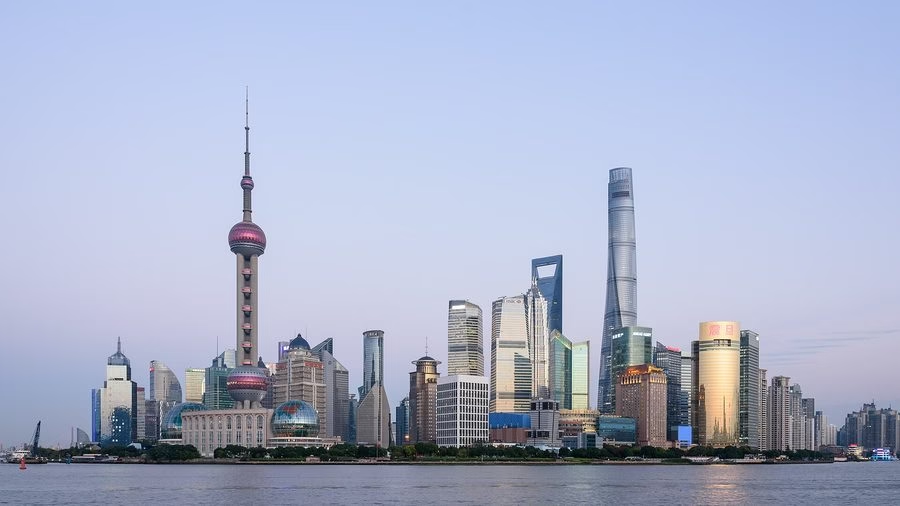
City selection is strategic, not arbitrary. Shanghai is China's commercial and financial capital — the default first stop for most business-focused missions. Shenzhen is the technology and manufacturing gateway, particularly relevant for hardware, electronics, and supply chain delegations. Beijing suits missions requiring government relations or policy-focused meetings. Guangzhou anchors manufacturing and sourcing missions. Chengdu is the recommended gateway for Western China market access — a city rarely featured by competing programs but increasingly important for consumer goods and agricultural exporters.
The full city-by-sector selection matrix appears in Step 5 below — with detailed guidance on which sectors belong in which city and why.
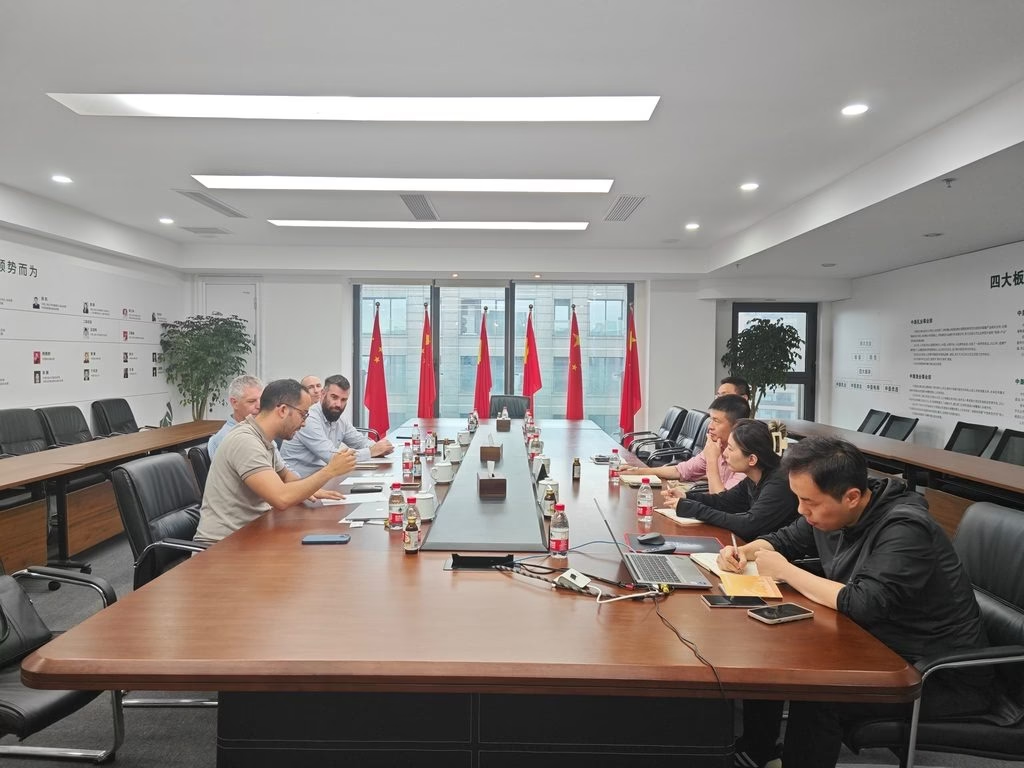
“China provides a promising yet challenging and competitive market for agricultural products.”
3. How to Plan a Trade Mission to China: A 9-Step Framework for Chamber Organizers
Organizing a trade mission to China requires a structured approach that most government program pages never explain. Here is the complete 9-step framework that InfluChina's China Business Tours team uses when designing delegations for chambers and associations:
- Define your mission objectives — member-aligned goals, sector focus, measurable outcomes
- Build your 12-month planning timeline — backward-plan from mission dates
- Select your Chinese ground partner — operator vetting, CCPIT engagement, embassy resources
- Recruit and qualify member delegates — export-readiness, sector fit, decision-maker authority
- Design the mission itinerary — city selection, B2B meetings, factory visits, receptions
- Structure the budget and pricing — included vs. excluded costs, grant matching
- Prepare delegates for China — culture, WeChat, visa, VPN
- Build a pre-mission digital presence — Chinese platform visibility before arrival
- Plan post-mission follow-up — WeChat strategy, ROI measurement, relationship continuity
Step 1 — Define Your Mission Objectives
The first step in organizing a China trade mission is defining specific, measurable objectives — both for the organizing chamber and for individual member delegates. Objectives determine every downstream decision: which city you visit, which sectors your ground partner targets for meetings, and how you qualify delegates.
Common objective types for Chamber-organized missions include:
- Market exploration: Delegates are assessing China's market potential for the first time — broad exposure across sectors and city types is appropriate.
- Partnership development: Delegates are seeking distributors, joint venture partners, or licensees — highly targeted, pre-qualified meetings with vetted Chinese counterparts are required.
- Sourcing and supply chain: Delegates need factory access and supplier relationships — Guangzhou and Shenzhen are the primary city choices.
- Government relations: Delegates are seeking regulatory guidance, sector approvals, or municipal partnerships — Beijing and CCPIT engagement are essential.
- Brand building and eCommerce entry: Delegates are entering the consumer market — Tmall, JD.com, and Xiaohongshu presence are part of the mission design.
Document objectives formally before any partner briefing or delegate recruitment. Vague objectives produce vague meetings — and vague meetings produce no ROI.
Step 2 — Build Your 12-Month Planning Timeline
Twelve months is the recommended minimum lead time for a well-executed China trade mission. Government-backed missions like WEDC and the Canadian Heritage program operate on equivalent lead times — and for good reason: CCPIT matchmaking, visa processing, interpreter booking, and delegate preparation all require significant runway.
12-Month Trade Mission to China Planning Timeline
| Timeframe | Key Actions | Responsible Party | Notes |
|---|---|---|---|
| 12 months out | Define mission objectives; identify ground partner candidates; set provisional dates | Chamber leadership | Avoid Chinese New Year (Jan–Feb) and Golden Week (early Oct) blackout periods |
| 9 months out | Confirm ground partner; initiate CCPIT contact; launch delegate recruitment | Chamber + ground partner | Canadian Heritage program caps at 40 companies — set your own delegation size limit early |
| 6 months out | Confirm delegate roster; begin B2B meeting matchmaking; design itinerary draft | Ground partner + chamber | Collect delegate company profiles for Chinese counterpart briefing packages |
| 3 months out | Confirm itinerary and B2B appointments; begin delegate preparation program; launch pre-mission digital presence | Chamber + InfluChina | Start WeChat Official Account setup and Xiaohongshu brand-seeding campaigns |
| 6 weeks out | Deliver cultural briefing to delegates; confirm visa status; distribute VPN guidance | Chamber | M visa applications should be submitted with adequate processing buffer |
| 2 weeks out | Final logistics confirmation; distribute delegate handbook; confirm interpreter assignments | Ground partner | Verify all delegate WeChat accounts are active and verified |
| During mission | Facilitate B2B meetings, factory visits, and receptions; manage WeChat connections in real time | Ground partner + chamber lead | Initiate WeChat connections during each meeting — not after returning home |
| Post-mission (weeks 1–4) | Send follow-up communications via WeChat within 48 hours; compile ROI data; debrief delegates | Chamber + delegates | Email alone will result in missed opportunities — WeChat is the primary channel |
Source: InfluChina, based on 25+ expeditions delivered.
4. How Do You Select a Chinese Ground Partner for a Trade Mission?
Selecting the right China-side ground partner is the single most consequential operational decision in trade mission planning. A strong ground partner does more than arrange logistics — they brief Chinese counterparts on your delegates, qualify meeting quality before departure, and provide on-the-ground support when plans change. For chambers exploring corporate delegations to China or broader China market entry strategy, the ground partner is the linchpin of the entire program.
What to Look for in a China-Side Operator
A strong ground operator is evaluated on capability, not just price. Key criteria include:
- Sector-relevant contact network: The operator must have established relationships in your delegates' target sectors — not just generic business contacts.
- B2B appointment experience: They should have a proven process for identifying, qualifying, and briefing Chinese counterparts before the mission begins.
- Interpreter quality: Technical and commercial interpreters are different competencies. Confirm the operator uses sector-appropriate language professionals.
- Crisis-management capability: Plans change in China. The operator must have local network depth to pivot itineraries, rebook venues, or escalate when meetings fall through.
- Transparent cost structure: The operator should clearly separate their service fee from third-party costs (venues, meals, transportation) to avoid post-mission disputes.
- Post-mission support: The best operators remain available for WeChat follow-up coordination and relationship continuity after delegates return home.
How the CCPIT Can Support Your Trade Mission
The CCPIT (China Council for the Promotion of International Trade) is the primary Chinese government body that facilitates foreign trade delegations, providing matchmaking services, official meeting arrangements, and access to Chinese government contacts for inbound business missions. It has regional offices across China — including in Shanghai, Shenzhen, Beijing, Guangzhou, and Chengdu — making it a versatile partner regardless of your itinerary.
Engaging CCPIT adds institutional credibility with Chinese counterparts that no private ground operator alone can replicate. Chinese businesses treat a CCPIT-endorsed delegation differently from a self-organized group — it signals official recognition and serious commercial intent. Your ground partner should have an existing CCPIT working relationship or be willing to initiate contact on your behalf.
Embassy and Consulate Resources for Mission Planners
Do not overlook the resources available through your home country's commercial representation in China. The U.S. Commercial Service (USCS) — referenced in the Snowsports Industries America China Trade Mission as an active mission partner — provides market intelligence, business matchmaking, and credentialing support for U.S.-based delegations. Equivalent services exist through the UK Department for Business and Trade, Canadian Trade Commissioner Service, and other national commercial bodies. Chinese embassies and consulates in your home country can also assist with mission credentialing, official letters of invitation, and facilitating CCPIT introductions before departure.
5. How to Design Your China Trade Mission Itinerary
A well-designed trade mission itinerary balances depth with executive feasibility. The goal is meaningful relationship-building across carefully chosen cities — not a rushed tour of every major Chinese metropolis. For missions focused on manufacturing and sourcing, explore InfluChina's dedicated China sourcing trips format as a complementary structure.
The Standard China Trade Mission Format (7–10 Days)
A standard trade mission to China runs 7–10 days — long enough for meaningful relationship-building across two cities, short enough for senior executives to commit. Reference points from current active programs:
- WEDC (Wisconsin Economic Development Corporation): 9-day mission (March 21–29)
- Snowsports Industries America: 6-day mission format
- Canadian Heritage: 5-day mission (October 2026 active program, capped at 40 companies)
A typical day structure runs: morning B2B meeting block (2–3 pre-arranged appointments), afternoon factory or site visit, evening reception or working dinner. One mid-mission official banquet or government reception is standard for institutionally backed delegations. A closing debrief session on the final day consolidates delegate learnings and sets post-mission action items.
Which Chinese City for Which Industry Sector?
City selection is one of the most consistently mishandled elements of trade mission design. Most current programs name Shanghai and Shenzhen without explaining why. The matrix below provides a sector-by-sector rationale.
Chinese City Selection Matrix by Industry Sector
| City | Best Sectors | Key Business Districts | Typical Mission Purpose | Notes |
|---|---|---|---|---|
| Shanghai (上海) | Finance, consumer goods, food & beverage, creative industries, retail | Pudong (finance), Jing'an (luxury/retail), Hongqiao (trade hub) | Market entry, distribution partnerships, brand launches | Most common first stop; strongest concentration of international business infrastructure |
| Shenzhen (深圳) | Technology, hardware, electronics, clean energy, manufacturing | Nanshan (tech), Futian (commerce), Longhua (manufacturing) | Supply chain, tech partnerships, innovation scouting | Home to Tencent, Huawei, DJI — essential for any tech-focused delegation |
| Beijing (北京) | Government relations, education, media, healthcare, policy-regulated sectors | Zhongguancun (tech/research), Chaoyang (diplomacy/commerce) | Government engagement, regulatory meetings, policy briefings | Add Beijing when your delegates need ministry-level access or CCPIT central office meetings |
| Guangzhou (广州) | Manufacturing, sourcing, textiles, electronics, trade fair access | Tianhe (commerce), Haizhu (manufacturing), Canton Fair venue | Supplier identification, factory visits, Canton Fair alignment | Align mission timing with Canton Fair (April and October) for maximum sourcing value |
| Chengdu (成都) | Food & agriculture, consumer goods, Western China market access, automotive | Tianfu New Area (business), Jinjiang (retail) | Western China market entry, regional distribution partnerships | Underused by most missions — significant opportunity for consumer goods and food exporters targeting inland China |
Source: InfluChina, based on 25+ expeditions delivered.
Most missions cover two cities to balance depth against executive availability. The most common pairing is Shanghai and Shenzhen. Beijing is added for government-relations-heavy delegations. For manufacturing-focused missions, Guangzhou and Shenzhen is the natural pair.
How to Recruit and Qualify Member Delegates
The ideal trade mission delegate is export-ready, sector-appropriate, and holds decision-making authority within their company. The Canadian Heritage program's 40-company delegation cap is a useful reference point — groups of 15–25 companies allow for meaningful individual meeting time without logistical chaos.
Qualify delegates against these five criteria before confirming their place:
- Export readiness: The company has a product or service with clear relevance to the Chinese market — not exploratory interest alone.
- Decision-making authority: The attending delegate can commit to next steps without returning home for board approval.
- Sector fit: The delegate's sector aligns with the mission's city and meeting program — mismatched delegates waste valuable appointment slots.
- Financial capacity: The company has budget allocated to follow up on mission introductions (travel, samples, legal fees for agreement drafting).
- Digital readiness: The company is prepared to invest in basic Chinese digital presence before arrival — or is willing to work with InfluChina to establish one.
6. What Does a Trade Mission to China Cost?
Trade mission costs depend on delegation size, mission duration, and cities visited — but the standard model separates a mission participation fee (covering ground logistics, interpreters, and meeting arrangement) from individual delegate expenses (international flights and hotel accommodation). Understanding this structure helps Chamber organizers price missions correctly for members and identify where grant support applies.
Government Grants and Matching Programs
Government financial support can significantly reduce the cost of a China trade mission for qualifying organizations. The most concrete publicly available example is the Food Export USA / USDA Agricultural Trade Office budget-matching program, which offers up to 50% cost matching for qualifying food and agricultural exporters participating in focused trade missions to China.
Chamber organizers should research equivalent programs in their home country or state before finalizing mission pricing:
- U.S.-based chambers: Explore USDA ATO matching programs, U.S. Commercial Service resources, and state-level export promotion grants (WEDC's model is a useful template).
- Canadian chambers: The Canadian Trade Commissioner Service and the CanExport program offer financial support for international market development activities.
- UK and European chambers: UK Export Finance and equivalent EU member-state programs provide trade mission support funding.
- Government-led missions: Programs like Canadian Heritage absorb certain costs through public funding — partner missions with government bodies where possible to reduce delegate fees.
“In our experience facilitating delegations across China, the single most common mistake foreign business delegations make is arriving without an active WeChat account. Chinese counterparts expect to connect the moment a meeting ends — not days later via email.”
7. How Should You Prepare Delegates for a Trade Mission to China?
Delegate preparation is the most consistently overlooked element of trade mission planning — and the most consequential. Your delegates' behavior in meetings, their digital readiness, and their visa status will determine whether introductions convert to relationships. Pair this preparation with strong WeChat marketing for businesses in China to maximize delegate effectiveness on the ground.
Chinese Business Culture and Etiquette Essentials
Guanxi (关系) is the Chinese concept of relationship-based business networking, in which trust and personal connection must precede commercial transactions — a principle that fundamentally shapes how trade missions to China must be designed, with relationship-building activities prioritized over transactional sales pitches. Prepare delegates on these behavioral essentials:
- Business card exchange: Present and receive cards with both hands, read the card carefully before setting it down — never write on it or pocket it immediately. WeChat QR code exchange is now an equally accepted alternative in many settings.
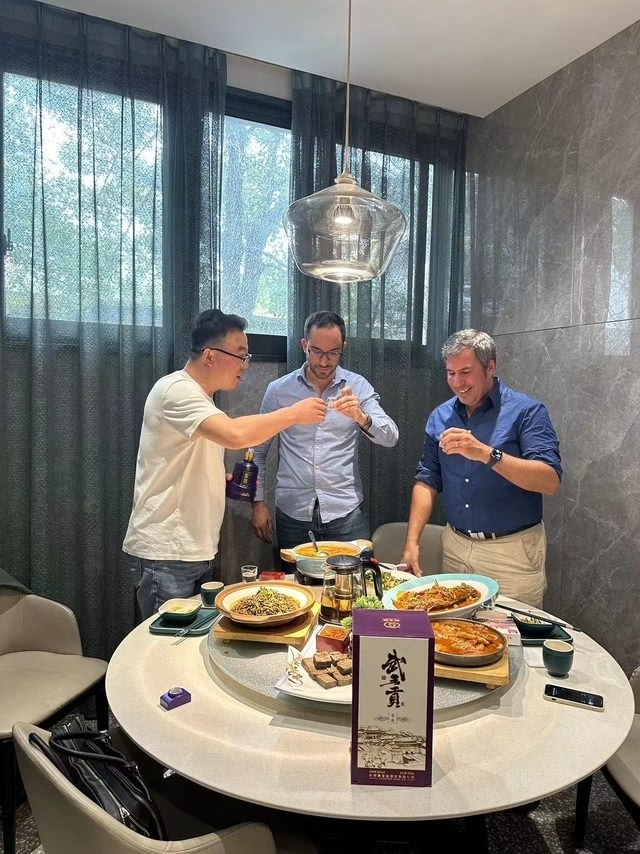
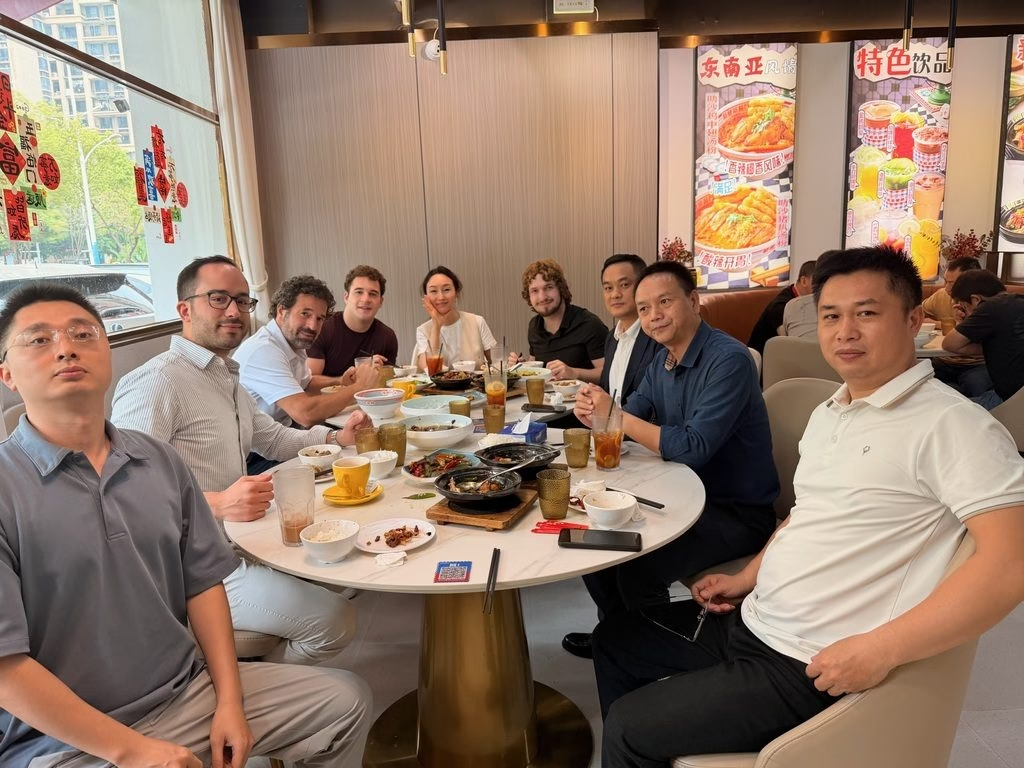
- Banquet culture: Formal dinners are relationship-building sessions, not social afterthoughts. Seating hierarchy matters — wait to be directed. Toasting is a ritual — respond appropriately even if drinking modestly.
- Decision-making hierarchy: The person in the room is rarely the final decision-maker in a Chinese company. Do not expect commitments in the first meeting — patience is a competitive advantage.
- Guanxi-first framing: Open meetings with genuine interest in your counterpart's business and context before presenting your own offer. Relationship precedes transaction — always.
- Face (mianzi): Never embarrass a Chinese counterpart in front of others. Disagreements are handled privately and diplomatically.
The WeChat Imperative: Digital Readiness Before Arrival
WeChat (微信) is the essential communication tool for any business delegate visiting China — functioning simultaneously as messaging app, business card exchange platform, payment system, and relationship management tool, with over 1.3 billion monthly active users as of 2024. Every Chinese business contact will expect to connect via WeChat immediately after a meeting. A delegate without an active WeChat account is operationally invisible in China.
Critical WeChat preparation steps for delegates:
- Download and activate before departure: WeChat account verification requires a foreign phone number and is significantly more difficult to complete from within mainland China.
- Set a recognizable profile: Use the delegate's full name and a professional photo — Chinese counterparts will search for and verify the account before or after meetings.
- Prepare a WeChat QR code: Have it printed or saved for immediate sharing at meetings — it replaces the paper business card exchange in many contexts.
- Join the mission WeChat group: The ground partner or chamber lead should create a dedicated WeChat group for all delegates and Chinese contacts during the mission.
Visa, VPN, and Practical Logistics for Delegates
The appropriate visa category for trade mission participants is the M visa (commercial and trade activities visa). M visa processing timelines vary by country — always verify current requirements with the Chinese embassy or consulate in your delegates' home country well in advance, as requirements change.
Additional practical logistics that delegates must prepare before departure:
- VPN configuration: Google, Gmail, WhatsApp, YouTube, and most Western apps are inaccessible in mainland China. Delegates must download and configure a VPN before departure. Note that VPN use in China sits in a regulatory grey area for foreign visitors — delegates should research current conditions independently.
- Offline maps and alternatives: Download Baidu Maps or Apple Maps offline before arrival. Google Maps does not function reliably in mainland China.
- Mission date blackout periods: Avoid scheduling missions during Chinese New Year (typically January–February) or Golden Week (early October — in 2026, Golden Week falls in the first week of October). Business activity drops sharply and many Chinese counterparts are unavailable during these periods.
Schedule a Free Delegation Consultation
8. Why Should You Build a Digital Presence in China Before the Mission?
Before a single meeting takes place, Chinese partners will research your delegates on Baidu (China's dominant search engine), WeChat, and sector-relevant platforms — and a missing digital presence sends a signal of unpreparedness. This is the single biggest operational gap that trade mission programs currently leave unaddressed — and it is where InfluChina's expertise creates a measurable advantage for delegate companies.
How Chinese Partners Research Foreign Companies Before Meetings
Chinese business counterparts do not use Google. They search Baidu, check WeChat Official Accounts, and look at Xiaohongshu or Weibo for sector-relevant brand presence. A foreign company with no Chinese digital footprint appears either unprepared or unserious — neither impression serves a trade mission delegate well.
The research pattern typically follows this sequence:
- Baidu search: Chinese counterparts will search your company name and product category in Chinese. If nothing appears, your credibility is immediately questioned.
- WeChat Official Account check: A verified WeChat Official Account signals that your company is committed to the Chinese market — not just visiting.
- Xiaohongshu or Weibo brand presence: For consumer goods, food, lifestyle, and creative industries, Chinese B2B and B2C audiences use these platforms to assess brand quality and market positioning.
Pre-Mission Brand Awareness on Chinese Platforms
A KOL (Key Opinion Leader) campaign seeded on Xiaohongshu or Douyin two to three months before a trade mission can fundamentally change the quality of on-the-ground meetings. A KOL-seeded brand presence means Chinese counterparts arrive at meetings already familiar with your delegates' products — turning cold introductions into warm conversations.
The pre-mission digital toolkit for trade mission delegates includes:
- WeChat Official Account setup: The B2B baseline. A verified account with Chinese-language content signals market commitment and provides a permanent communication channel for post-mission relationship management.
- Xiaohongshu marketing: For consumer goods, food, beauty, and lifestyle brands, content seeding on Xiaohongshu builds brand recognition with the Chinese consumers and buyers your delegates will meet.
- Douyin influencer campaigns: Short-form video content on Douyin delivers rapid brand awareness at scale — particularly effective for food, fashion, and technology sectors in the weeks before a mission.
- KOL marketing in China: InfluChina's database of 250,000+ influencers across all tiers enables highly targeted pre-mission brand seeding in exactly the sectors and cities your delegates will be visiting.
The pre-mission window of 8–12 weeks is the optimal timeframe to activate these campaigns — long enough to build meaningful brand recognition, short enough to remain relevant when delegates arrive for meetings.
9. How Do You Convert Trade Mission Introductions Into Business Relationships?
Converting trade mission introductions into business relationships requires a structured follow-up strategy through Chinese channels — primarily WeChat — with the first contact made within 48 hours of each meeting. Delegates who return home and follow up exclusively by email will lose the majority of the relationships they built on the mission. Explore how to enter the Chinese market for a broader strategic framework that post-mission relationship management feeds into.
Following Up Through Chinese Channels
Post-mission follow-up in China happens primarily through WeChat — not email. The follow-up model that consistently produces results:
- Connect during the meeting, not after: WeChat connections should be made while delegates and Chinese counterparts are still in the same room — exchange QR codes before leaving.
- 48-hour follow-up message: Send a personalized WeChat message to each new contact within 48 hours of the meeting. Reference a specific conversation point to demonstrate genuine attention.
- Create a mission WeChat group: The chamber lead or ground partner should create a WeChat group encompassing all mission delegates and willing Chinese contacts for ongoing group communication.
- Assign a Chinese-speaking liaison: Email responses from China are often slow or absent. A Chinese-speaking follow-up contact — whether in-house or through a partner like InfluChina — significantly improves response rates and relationship continuity.
- Maintain regular contact rhythm: Relationships built on guanxi require ongoing maintenance. Share relevant industry news, send greetings at Chinese New Year, and schedule check-in calls to sustain the relationship between missions.
Measuring Trade Mission ROI for Member Delegates
Measuring mission ROI justifies future program investment and strengthens the Chamber's member value proposition. Track these five KPIs for every mission:
- Number of qualified B2B meetings attended per delegate: Measures the matchmaking quality of your ground partner and the relevance of your delegate qualification process.
- MOUs or letters of intent signed during the mission: The most immediate indicator of meeting quality and relationship depth achieved on-the-ground.
- Follow-up meetings scheduled within 30 days of return: Measures the effectiveness of your post-mission follow-up strategy and the strength of connections made.
- Business partnerships formed within 12 months: The medium-term output measure that validates the mission's commercial value to member delegates.
- Export sales attributed to mission contacts within 24 months: The ultimate ROI measure — tracks whether mission introductions translated into actual revenue for member companies.
How InfluChina Supports Trade Mission Planning
InfluChina's China business tours and trade missions to China service is built specifically for chambers of commerce, industry associations, and corporate groups who need a bespoke, end-to-end China delegation program. With 6+ years of China market experience (via WeNomad), 400+ campaigns launched, and 50+ brands and agencies served, InfluChina brings both operational depth and digital marketing expertise that no logistics-only ground operator can replicate.
What InfluChina delivers for Chamber-organized trade missions:
- Mission design and ground support: Full itinerary design, ground partner coordination, B2B matchmaking, and on-the-ground logistics management across Shanghai, Shenzhen, Beijing, Guangzhou, Hangzhou and Hong Kong.
- Delegate preparation program: Cultural briefing sessions covering guanxi, business etiquette, WeChat setup, VPN guidance, and M visa timelines — delivered before departure to give delegates a genuine operational advantage.
- Pre-mission KOL and influencer campaigns: Access to InfluChina's 250,000+ influencer database enables targeted brand-seeding campaigns on Xiaohongshu and Douyin in the weeks before your mission — so Chinese counterparts arrive at meetings already familiar with your delegates' brands.
- WeChat Official Account setup: InfluChina's social media management team can establish and manage WeChat Official Accounts for delegate companies, creating a permanent Chinese digital presence that outlasts the mission itself.
- Post-mission follow-up strategy: InfluChina's China-based team can manage ongoing WeChat communication and relationship maintenance on behalf of delegate companies that lack in-house Chinese-language capability.
With 1,000+ influencers activated and 1 billion+ consumers reached across our campaigns, InfluChina combines on-the-ground delegation management with the full Chinese platform marketing ecosystem.
Start Planning Your Chamber's Trade Mission to China
“A successful trade mission to China is not a trip — it is a structured program of relationship-building, digital preparation, and strategic follow-up that begins months before departure and continues long after delegates return home.”
Plan Your China Trade Mission With Confidence
A trade mission to China is one of the highest-impact international trade programs a chamber of commerce can offer its members — but only when it is designed with China-specific operational depth. The 9-step framework in this guide covers the China-specific layer of mission planning: city-sector strategy, WeChat delegate preparation, pre-mission digital presence, and post-mission follow-up through Chinese channels.
Ready to bring your chamber to China? Contact InfluChina's China Business Tours team to start planning your delegation.
